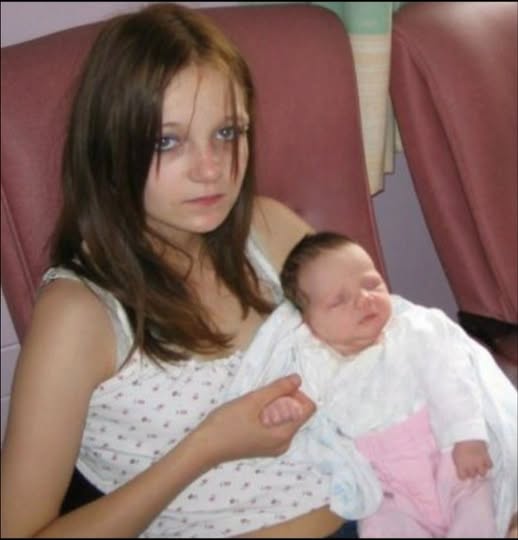
In 2006, the United Kingdom was gripped by a story that transcended mere news, becoming a cultural flashpoint that exposed deep societal wounds. The face of Tressa Middleton, a quiet, unremarkable girl from Broxburn, Scotland, was suddenly plastered across every national front page. At the age of twelve years and eight months, she was the youngest mother in Britain, a fact that instantly stripped her of her anonymity and thrust her into the unforgiving glare of public scrutiny. She was instantly transformed into a symbol—misunderstood, judged, and sensationalized—her actual identity buried beneath a mountain of tabloid fervor.
What the public consumed was a shallow, dangerous simplification of a far more devastating reality. Behind the shocking headline lay a truth so painful, so profound, that Tressa could not articulate it for years. Her story is not simply the chronicle of a very young pregnancy; it is a harrowing indictment of systemic failure, a testament to unimaginable childhood trauma, and ultimately, a difficult chronicle of resilience and the fight to reclaim a life stolen by abuse.
Long before the national media assigned her the title of “Britain’s youngest mother,” Tressa’s life was defined by fundamental instability. Born in 1994, her early years were shadowed by poverty and insecurity. When she was just four, the family’s situation crumbled, her mother lost their home, and Tressa entered the confusing, often inadequate world of foster care. She later recounted this separation with heartbreaking simplicity: “My mom was homeless, so I had to go into care.”
Her early adolescence was a landscape devoid of the protection and innocence that childhood demands. Lacking a secure support system, she gravitated toward older peers, a path that led to destructive coping mechanisms at a startlingly young age. She recalled having her first drink between eight and nine years old—a stark indication of how quickly she was forced to mature and the scarcity of reliable, nurturing adult guidance in her environment. Her upbringing was a continuous lesson in survival: navigating neglect, dealing with severe food scarcity, and enduring housing conditions—like an apartment with insufficient heating—that amplified her extreme vulnerability.
The true, horrifying secret began when Tressa was just seven years old. The abuse she suffered was at the hands of her older brother, Jason, who weaponized her vulnerability and her family’s instability against her. She endured years of manipulation, threats, and being bribed with small concessions like alcohol and cigarettes, which only deepened her sense of isolation and shame.
When she was eleven, a friend urged her to take a pregnancy test. The memory of waiting for the result, seeing the two faint lines appear, was a moment of overwhelming fear and utter confusion. Her home life, already strained by poverty, erupted into chaos when her mother discovered the truth, screaming in disbelief in the street.
To shield herself from the devastating, immediate collapse of her world, Tressa fabricated a lie. She told her family and the authorities that the father was a local boy, a child close to her age. This single, desperate, protective lie allowed the tabloids to craft the narrative they desired: a reckless, troubled girl. Tressa was judged harshly by a public utterly ignorant of the years of trauma and silent suffering she carried. She didn’t have the emotional language or the stability required to disclose the truth of the incest and abuse.In 2006, the child became a mother. Tressa gave birth to her daughter, Annie, and the media frenzy reached a fever pitch. Reporters camped outside her doorstep, combing through the remnants of her privacy. Despite the shocking circumstances, Tressa bonded fiercely with her daughter, loving Annie with a deep, primal protectiveness. Yet, the overwhelming pressure of motherhood combined with the constant media siege and the unresolved, crushing trauma proved too much for a girl who was still a child herself.
The emotional turmoil spiraled into severe depression. Unable to cope with the pain, she began turning to substances to numb the terror and grief she couldn’t escape. By the age of fourteen, social services were forced to intervene, determining she could no longer provide a stable environment. Annie was removed from her care and later adopted, a loss that tore Tressa’s world apart. She vividly recalled one of her last visits: “She cried for her new parents… not for me. It broke my heart.”
In 2009—three years after Annie’s birth—the protective lie finally shattered. Tressa found the courage to reveal the agonizing truth: her brother, Jason, was the father of her daughter, the result of years of sexual abuse that began when she was seven. A full investigation and DNA testing confirmed the horrific truth, leading to Jason’s conviction and sentencing to four years in prison.The nation, initially quick to judge Tressa, was forced into a wrenching re-evaluation. But for Tressa, the conviction provided little immediate comfort. She was left grappling with immense psychological trauma, burdened by guilt, shame, and the consuming grief of having lost her daughter. Her mental health deteriorated sharply, leading her to heroin and other substances in a desperate bid to find oblivion. She admitted to spending hundreds of pounds a day, not for pleasure, but because, as she later articulated, “I didn’t want to feel anything.”
Her salvation arrived slowly, in the steady, patient form of her partner, Darren. He offered the consistent, compassionate support she had never known, acting as the anchor she had always needed. Slowly, painfully, Tressa began the long, arduous process of recovery. She broke free from addiction and started the difficult work of rebuilding her emotional strength and mental health.
The journey was marked by further tragedy. In 2012, Tressa suffered a devastating miscarriage, followed just three days later by the death of her mother from pneumonia. The dual loss threatened to pull her back into the depths of despair. At her mother’s funeral, she encountered Jason, who was allowed to attend to carry the coffin. They did not speak, but stood together, crying, weighed down by the unspoken pain of their shared, catastrophic history. Over time, Tressa reached a difficult, necessary place of forgiveness. Not because she excused the abuse, but because she recognized that carrying the hatred was only prolonging her own suffering. “Forgiveness didn’t mean forgetting,” she reflected. “It meant freeing myself.”By 2018, Tressa had rewritten her chapter, welcoming a new daughter, Arihanna, into her stable life with Darren. The birth was emotionally charged, a complex mixture of present joy and the lingering sorrow for the child she had lost. She vowed that her children would be raised in openness and honesty, emphasizing that Annie would never be a secret. By 2023, Tressa, living in Bathgate, was expecting her third child, her life now a testament to enduring stability and resilience. She admitted that Annie remained in her thoughts every morning and every night, proof that love, even when separated by circumstance, never truly fades.
Tressa Middleton’s story endures not for the sensational headline it produced, but for the stark, uncomfortable truth it revealed about how society often fails its most vulnerable. It demonstrates how poverty creates vulnerability, how systemic neglect can allow abuse to flourish unnoticed, and how survivors are judged and ostracized long before they are understood. Her life is a powerful, difficult lesson in the complexity of trauma, and a hopeful affirmation that even from the darkest circumstances, healing, love, and a new life are always possible. She found the courage to reclaim her voice, proving that one can, with immense difficulty and strength, become far more than the pain endured.