CHAPTER 1: THE LONG WALK HOME
The silence in the rental car was heavier than the rucksack sitting in the passenger seat. It was a silence I wasn’t used to. For the last nine months, my world had been defined by noise—the roar of engines, the static of radios, the percussive thud of distant artillery, and the constant, grating shouting of men trying to stay alive in impossible situations.
Now, driving through the winding, tree-lined streets of Oakhaven, Illinois, the quiet was almost unnerving. The only sound was the heater humming, trying to battle the biting November chill outside.
I checked my watch. 10:15 AM. The assembly at Oakhaven Academy started at 10:00. I was late.
I caught a glimpse of myself in the rearview mirror. Sergeant Elias Thorne. I looked like hell. My eyes were rimmed with red, sunken deep into a face that hadn’t seen a razor in three days. I was still wearing my fatigues. There hadn’t been time to change at the base, and I sure as hell wasn’t going to stop at a hotel. I had a mission. It was a different kind of mission than the ones I was used to, but it was the only one that mattered now.
I needed to get to Toby.
Toby was my little brother. Ten years old. A surprise baby, born when I was already graduating high school. When our parents died in that pile-up on I-90 two years ago, I became his legal guardian. But I was deployed. I had to leave him with our Aunt Karen, a woman who meant well but didn’t have a maternal bone in her body, and who thought sending Toby to a prestigious boarding school was the best way to “handle the situation.”
I gripped the steering wheel until my knuckles turned white. Handle the situation. As if Toby were a logistics problem to be solved.
I pulled up to the wrought-iron gates of Oakhaven Academy. It looked less like a school and more like a fortress for the children of the elite. Brick buildings covered in ivy, manicured lawns that defied the winter frost, and a security guard booth that looked more serious than some checkpoints I’d passed through overseas.
The guard stepped out, eyeing my car. It was a beat-up sedan, a stark contrast to the parade of Range Rovers and Mercedes parked in the lot. He saw me through the glass—my uniform, the subdued American flag patch on my shoulder. His posture changed instantly. He straightened up, a look of confusion mixing with respect.
I rolled down the window. The cold air rushed in, smelling of snow and dead leaves.
“Can I help you, Sergeant?” he asked.
“I’m here for the assembly,” I said, my voice rasping. “My brother is a student. Toby Thorne.”
The guard hesitated. “The ceremony has already started, sir. Principal Vance is pretty strict about closed doors…”
I just looked at him. I didn’t try to intimidate him; I didn’t have the energy for it. I just let him see the exhaustion and the desperation in my eyes. I let him see that I had traveled seven thousand miles to be here and that a locked door wasn’t going to stop me.
He glanced at the gate, then back at me. He nodded once. “Park in the back, near the gym entrance. It’s unlocked for the caterers. Welcome home.”
“Thanks,” I muttered.
I parked the car and killed the engine. I sat there for a second, my hands shaking slightly. It was adrenaline withdrawal, mixed with a terrifying anxiety. I could dismantle an IED, but the thought of walking into a room full of rich suburbanites and seeing my little brother made my stomach turn.
I grabbed my beret from the dashboard, tucked it into my pocket, and stepped out. The wind bit through my uniform, but I barely felt it. I walked toward the gym, my combat boots crunching on the gravel.
Inside, the hallway was warm and smelled of floor wax. I could hear a voice echoing over a PA system. It was sharp, distinct, and condescending. I recognized the tone. It was the tone of someone who demands respect but has never actually earned it.
I pushed through the double doors at the back of the auditorium.
CHAPTER 2: THE TRIBUNAL
The auditorium was cavernous, bathed in warm, theatrical light. Hundreds of parents sat in plush folding chairs, a sea of wool coats and designer scarves. They were silent, their attention fixed on the stage.
I stayed in the shadows of the back wall. I didn’t want to cause a scene. Not yet. I just wanted to find him.
On the stage, sat in neat rows, were the students of Oakhaven. They looked like terrifying little dolls. Boys in navy blazers and gray slacks, girls in plaid skirts and blazers. They sat with perfect posture, hands folded in their laps. It was unnatural. Ten-year-olds shouldn’t sit that still.
And there she was. Principal Eleanor Vance.
She stood at a mahogany podium, dominating the room. She was a tall woman, thin and angular, wearing a beige suit that probably cost more than my car. Her hair was blonde, cut into a sharp bob that didn’t move when she turned her head.
“Achievement,” she was saying. “It is not given. It is taken. At Oakhaven, we prepare your children for the real world. And the real world does not care if you tried. The real world cares if you succeeded.”
I scanned the faces on the stage. Where was he?
Then I saw him. Third row, on the far left.
Toby.
He looked miserable. His blazer was clearly a hand-me-down or bought a size too big to “grow into,” bunching up at the shoulders. His hair, usually a messy mop of brown curls, had been plastered down with gel. But it was his face that broke me. He looked pale, his eyes fixed on his shoes. He looked like he was waiting for a blow to land.
“We have given out the awards for Academic Excellence,” Vance continued, her voice clipping through the air. “And the awards for Athletic Superiority. Now, we come to the… discretionary submissions.”
She said the word discretionary like it tasted like sour milk.
“Some students,” she said, a small, cruel smile playing on her lips, “felt that the standard categories were too… restrictive. They petitioned to submit their own achievements for recognition.”
A few parents chuckled. It was a nervous sound. They knew Vance’s reputation. She was a bully who hid behind academic rigor.
“Toby Thorne,” she called out.
I froze. Toby’s head snapped up. He looked terrified. He didn’t move at first.
“Mr. Thorne,” she repeated, sharper this time. “Front and center.”
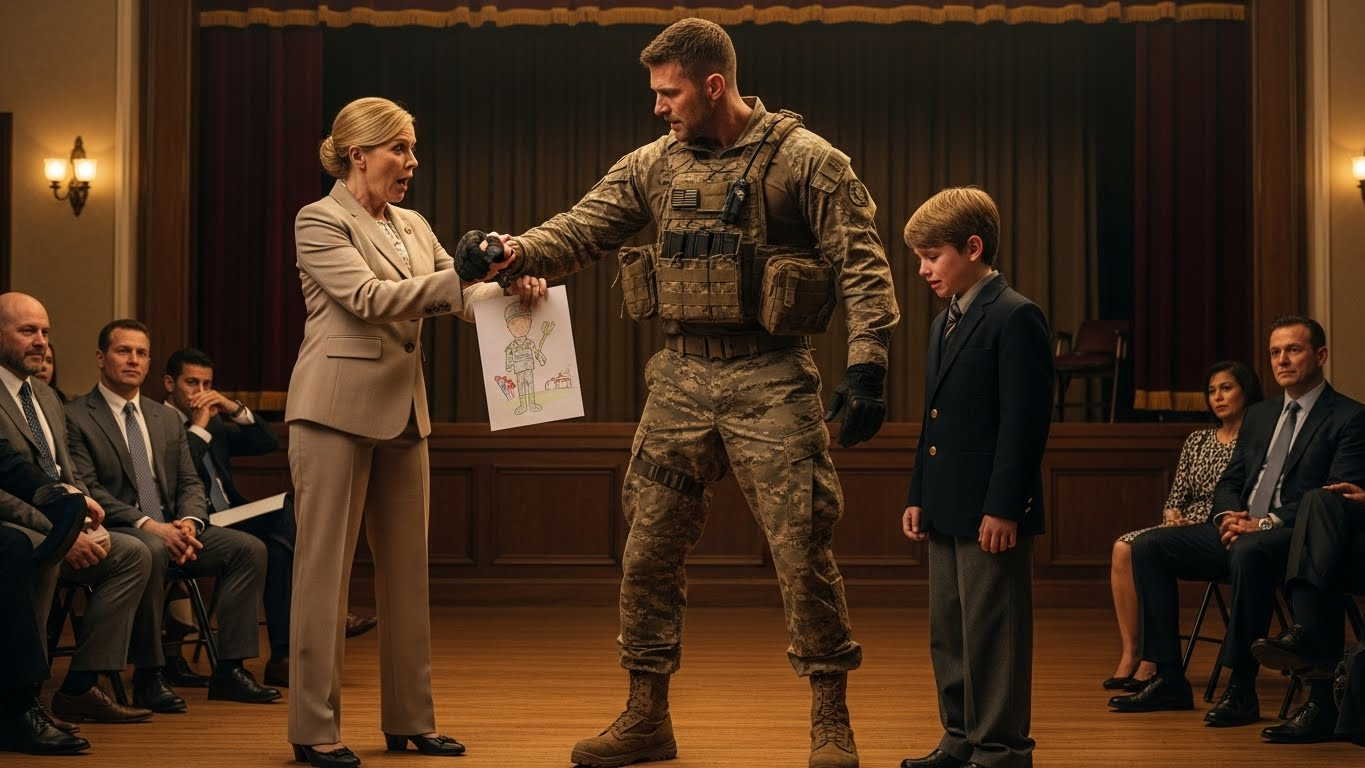
Toby stood up. He was holding something. A piece of construction paper. It was bright yellow, contrasting violently with the muted tones of the stage. He walked toward the podium, his legs stiff.
“Toby submitted this,” Vance said. She didn’t take it from him gently. She snatched it.
She held it up. From the back of the room, I squinted. It wasn’t a certificate. It was a drawing. It was crude, drawn with crayons, but the shapes were distinct. A tall figure in green and brown. A smaller figure next to him. And a jagged American flag in the background.
“Toby calls this the ‘Brotherhood Award,’” Vance announced. “He claims that his achievement this semester was… and I quote… ‘Being brave while Elias is gone.’”
The silence in the room changed. It wasn’t respectful anymore. It was awkward.
“Bravery,” Vance mused, looking at the drawing with disdain. “An interesting concept. But at Oakhaven, we define bravery through leadership. Through debate club victories. Through winning.”
She looked down at Toby. He was trembling so hard I could see it from fifty feet away.
“This,” she said, shaking the paper, “is not an achievement, Mr. Thorne. This is a cry for attention. It is a disruption. And it is a waste of paper.”
My blood ran cold. Then, it boiled.
“We do not reward emotional outbursts,” she said. “We correct them.”
She raised her hands. Her fingers pinched the top of the drawing. She was going to tear it. She was going to rip it in half right in front of him, in front of five hundred people.
I didn’t think. I didn’t plan. The soldier in me took over. The part of me that reacts to threats before my brain even processes them.
I pushed off the back wall.
“Trash,” she said.
The sound of the paper beginning to tear—that distinct, dry crak—was the trigger.
I moved down the center aisle. I wasn’t walking; I was marching. A combat pace. My boots slammed against the hardwood floor, echoing like gunshots in the quiet hall.
THUD. THUD. THUD.
Heads turned. Eyes widened.
“Excuse me!” Vance shouted, looking up, annoyed. She saw a figure approaching, but the stage lights were in her eyes. She couldn’t see who it was. “Security! Remove this intruder!”
I didn’t stop. I reached the base of the stage. I vaulted up the stairs, ignoring the gasp that ripped through the crowd.
Vance had the paper taut between her hands. She was staring at me now, her eyes adjusting. She saw the camouflage. She saw the size of me.
She froze, but her hands were still tense, ready to finish the tear.
I closed the distance in two strides.
My right hand, clad in my tactical glove, shot out. I grabbed her wrist—the one holding the top of the drawing. I gripped it hard.
The room went dead silent.
“I wouldn’t do that,” I growled.
CHAPTER 3: THE INTERVENTION
The sensation of my glove against her wrist seemed to shock her more than the physical pressure. It was foreign—rough leather and hard polymer knuckles against her smooth, manicured skin.
Principal Vance gasped, a sharp intake of air that sounded like a tire puncturing. She looked down at my hand, then up at my face. She was tall, but I was six-foot-four in my boots. I loomed over her, blocking out the stage lights.
“Let go of me!” she shrieked, her voice cracking. It was the first time she sounded uncomposed. She tried to yank her hand back, but I held fast. I wasn’t hurting her, not really. I was just immovable.
“You rip that paper,” I said, my voice low and dangerous, “and we’re going to have a very different conversation.”
I looked past her, down at Toby.
He was staring at me, his eyes wide as saucers. His mouth hung open. He looked like he was seeing a ghost.
“Eli?” he whispered. It was barely a sound.
“I got you, buddy,” I said, not taking my eyes off Vance. “I’m here.”
Vance rallied. She was a woman used to absolute authority, and her indignation was overriding her fear. “Who do you think you are? You are assaulting a school administrator! I will have you arrested! Security!”
Two security guards—older guys, retired cops mostly—were jogging down the aisle now. They looked hesitant. They saw the uniform. They saw the stance. They knew body language, and they knew I wasn’t an active shooter. I was a man making a point.
“Let go,” I said to Vance. “Of the paper.”
She glared at me, her face flushing a blotchy red. “This is school property—”
“It’s a drawing,” I cut her off. “It belongs to him.”
She hesitated, then her fingers loosened. I gently pulled the yellow construction paper from her grip. It was torn slightly at the top, a jagged inch-long rip, but it was intact.
I released her wrist. She stumbled back a step, rubbing her arm, looking at me with pure venom.
“You have no right,” she hissed. “Disrupting a ceremony! This is a private institution!”
I ignored her. I turned my back on her—the ultimate insult to someone like Vance—and knelt down on one knee. I was now eye-level with Toby.
The crowd was murmuring now. A low buzz of confusion and excitement. Phones were out. I could feel the lenses pointed at us.
“Hey, T-Bear,” I said softly, using the nickname I hadn’t used in a year.
Toby didn’t speak. He just launched himself at me.
He hit my chest with a force that almost knocked me over. His little arms wrapped around my neck, burying his face in the rough fabric of my fatigue jacket. He started to sob. Not the quiet, polite crying he probably did in his dorm room, but deep, heaving sobs that shook his whole body.
“I thought you weren’t coming back,” he choked out. “Aunt Karen said… she said soldiers don’t come back for awards.”
I wrapped my arms around him, pulling him tight. I smelled his shampoo and the faint scent of crayons. I closed my eyes, fighting back the burn in my own throat.
“I’m always coming back for you,” I whispered. “Always.”
I stood up, lifting him with me. He was too big to be carried, really, but I didn’t care. I held him on my hip like he was a toddler. He buried his face in my neck.
I turned back to Vance. She had regained some of her composure. She was adjusting her jacket, smoothing her hair. The security guards had reached the stage but stopped at the bottom of the stairs, unsure of what to do.
“Put the child down,” Vance commanded. She grabbed the microphone again. “Ladies and gentlemen, I apologize for this… display. Obviously, this man is mentally unstable. PTSD is a terrible thing, but—”
The room temperature seemed to drop ten degrees.
“Unstable?” I said. I didn’t need the microphone. I had the voice of a Non-Commissioned Officer. It carried.
I looked out at the audience. “My name is Sergeant Elias Thorne. I am this boy’s legal guardian. I just returned from a nine-month deployment.”
I held up the yellow paper. The drawing of us.
“My brother made this,” I said, projecting to the back of the room. “He made this because he’s been alone. Because the only family he has was halfway across the world.”
I turned my gaze back to Vance.
“And you wanted to tear it up because it wasn’t ‘excellent’ enough for you?”
CHAPTER 4: THE TURN OF THE TIDE
Vance stiffened. She realized she was losing the room. The parents weren’t chuckling anymore. They were watching with rapt attention. Some of the mothers had their hands over their mouths.
“We have standards, Sergeant Thorne,” Vance said, her voice icy. “We do not coddle children. We teach them that the world is harsh.”
“The world is harsh,” I agreed, stepping closer to the podium. Toby was still clinging to me. “I know exactly how harsh the world is. I’ve seen things in the last six months that would make you crumble.”
I gestured to the rows of terrified children on the stage.
“But these are kids. They aren’t soldiers. They aren’t employees. They’re children.”
“This is an elite academy!” Vance snapped, losing her cool again. “We build leaders! Not… not crybabies who draw pictures!”
“A leader,” I said, cutting her off, “protects their people. A leader builds them up. A leader doesn’t humiliate a ten-year-old boy in front of a crowd to make themselves feel powerful.”
A single clap rang out.
It was sharp and lonely.
I looked out into the audience. In the second row, a man in a grey suit had stood up. He was older, maybe sixty. He looked like a banker or a CEO.
He clapped again. Then again.
Then the woman next to him stood up.
Vance looked out, stunned. “Mr. Henderson? Mrs. Galloway?”
Slowly, the applause began to spread. It wasn’t a thunderous ovation at first; it was a ripple. But it grew. People were standing up. Parents who were tired of the pressure. Parents who secretly hated the way Vance made their kids cry over a B-minus.
The security guards looked at each other, then took a step back. They weren’t going to drag a soldier off the stage while the parents applauded him.
Vance gripped the podium, her knuckles white. She looked small now. The power she projected was fragile, built entirely on fear and social compliance. And I had just broken the compliance.
“This is absurd!” she shouted into the mic, but her voice was drowned out by the applause.
I looked at Toby. He had lifted his head. He was looking at the crowd, then at me. A small, tentative smile broke through his tears.
“Is this for us?” he asked.
“It’s for you, kid,” I said. “It’s for the drawing.”
I looked back at Vance. She was trembling with rage. She leaned into the mic, shouting over the noise. “Get out! Take your brat and get out of my school! I expel him! You hear me? He is expelled!”
The clapping stopped instantly. The threat of expulsion at Oakhaven was a death sentence in this social circle. The room held its breath.
I looked at her calmly.
“You can’t expel him,” I said.
“I am the Principal!” she shrieked. “I can do whatever I want!”
“Actually,” a deep voice came from the side of the stage.
Everyone turned.
A man in a wheelchair was rolling himself out from the wings. He was elderly, frail, with a blanket over his knees. But his eyes were sharp.
It was Mr. Oakhaven. The founder’s grandson. The honorary chairman of the board. He rarely appeared in public.
Vance went pale. “Mr. Chairman… I… I didn’t know you were attending.”
“I was watching from the wings, Eleanor,” the old man said. He didn’t have a microphone, but the acoustics carried his voice. “I saw the whole thing.”
He rolled his chair to the center of the stage, stopping next to me. He looked up at me and nodded. Then he looked at the patch on my shoulder. He tapped his own chest, over his heart.
“Korea. 1952,” he murmured to me.
“Afghanistan. Present day,” I replied softly.
Mr. Oakhaven turned his wheelchair to face Vance.
“You are relieved of your duties, Eleanor,” he said. His voice was quiet, final.
Vance’s mouth dropped open. “You… you can’t. The board…”
“I am the board,” he said. “And I am disgusted.”
He turned to the audience.
“There will be a new administration by Monday. One that understands that ‘excellence’ does not mean ‘cruelty’.”
He looked up at me. “Sergeant, if you would be so kind… I believe your brother deserves his moment.”
CHAPTER 5: BLUE LIGHTS AND LIES
The applause had died down, replaced by a tense, murmuring energy as the auditorium emptied. Mr. Oakhaven had wheeled himself away to speak with the board members who were frantically texting in the corner.
I walked Toby out of the double doors, his hand gripping mine so tight his knuckles were white. He hadn’t let go since I picked him up.
“Is she really fired?” Toby asked, looking up at me. His eyes were red, but the terror was gone, replaced by a cautious hope.
“Looks that way, bud,” I said, ruffling his hair. “But people like that… they don’t go down easy.”
I should have listened to my own gut.
As we pushed through the main exit into the biting cold of the parking lot, I didn’t see the grey sky. I saw flashing red and blue lights.
Three police cruisers were parked in a semi-circle around my beat-up rental car. Officers were standing by the doors, hands resting near their holsters.
And there, standing by the lead cruiser, was Principal Vance. She wasn’t crying. She looked composed, smug even. She was pointing a long, manicured finger directly at me.
“That’s him!” she shouted, her voice cutting through the wind. “That’s the man who assaulted me! He’s armed and dangerous! He has PTSD!”
Two officers stepped forward. “Sir! Stop right there! Hands where we can see them!”
I froze. The instinct to reach for a weapon flared and died in a millisecond. I was back in the real world. I couldn’t escalate this. Not with Toby standing right next to me.
“Eli?” Toby’s voice trembled.
“It’s okay, T-Bear,” I said, keeping my voice calm, though my heart was hammering against my ribs like a trapped bird. “Just stand behind me.”
I raised my hands slowly, palms open. “I’m Sergeant Elias Thorne. I am unarmed. My nephew is with me.”
“He grabbed me!” Vance shrieked, playing to the crowd of parents now exiting the building. “He crushed my wrist! He threatened to kill me! He’s a violent maniac!”
The lead officer, a burly man with a mustache, approached cautiously. “Sir, turn around. Interlace your fingers behind your head.”
“Officer, this is a misunderstanding,” I said, complying slowly. “I stopped her from humiliating a student.”
“We’ll sort it out at the station,” the officer said. He wasn’t rough, but he was firm. He cuffed me. The metallic click of the handcuffs echoed in the cold air.
Toby screamed. “No! You can’t take him! He just got home!”
He tried to run to me, but a female officer gently caught him by the shoulders. “It’s okay, sweetie. We just need to ask him some questions.”
“He’s my brother!” Toby sobbed, thrashing in her grip.
I twisted my head back. “Toby! Look at me!”
He froze, tears streaming down his face.
“I’ll be back,” I promised, staring into his eyes. “Call Aunt Karen. I will be back. That’s a promise.”
Vance was watching with a satisfied smirk. She had turned the narrative. She knew she was fired, but she was going to make sure I went down with her. She was banking on the stigma. The “crazy veteran” trope.
They shoved me into the back of the cruiser. As we pulled away, I watched Toby standing in the snow, looking smaller than ever.
The rage I felt then was colder than the winter air. It was a focused, tactical rage. Vance had made a mistake. She thought she was fighting a brute. She didn’t realize she was fighting a strategist.
CHAPTER 6: THE HOLDING CELL
The interrogation room at the Oakhaven Police Precinct smelled of stale coffee and industrial cleaner. I had been sitting there for three hours. They had taken my shoelaces and my belt.
I sat with perfect posture, staring at the two-way mirror. I knew the drill.
The door opened. The burly officer—Officer Miller, his badge said—walked in, followed by a younger guy in a suit. A detective.
“Sergeant Thorne,” the detective said, sitting down and opening a file. “I’m Detective Rys. We have a statement from Eleanor Vance alleging Assault and Battery, Terroristic Threats, and Disorderly Conduct. She claims you crushed her wrist and said—quote—’I’m going to end you.’”
I didn’t blink. “That’s a lie. I said, ‘I wouldn’t do that.’ And I removed a piece of paper from her hand.”
“We have witnesses who saw you storm the stage,” Rys said.
“And you have five hundred witnesses who saw her about to tear up a ten-year-old’s drawing,” I countered. “Did you interview them? Or just the lady in the expensive suit?”
Rys sighed. He looked tired. “Look, Sergeant. I respect your service. But Vance is well-connected. She’s pushing for charges. She’s claiming you’re unstable. She brought up your deployment history. Said you’re a ticking time bomb.”
“She’s trying to cover her own ass because she got fired publicly by the owner of the school,” I said.
Rys paused. “She got fired?”
“Ask Mr. Oakhaven,” I said. “He was there.”
Rys exchanged a look with Miller.
“Here’s the problem, Elias,” Rys said, leaning in. “Vance also called Child Protective Services. She claims that since you were detained for a violent crime, Toby is in an unsafe environment. She’s trying to get him placed in emergency foster care pending an investigation into your Aunt’s fitness as a guardian.”
My blood ran cold. The cuffs, the jail cell—none of that mattered. But Toby in the system? Toby in a foster home with strangers?
“You let me make a phone call,” I said, my voice dropping an octave. “Right now.”
“You already called your Aunt,” Miller said.
“Not her,” I said. “I need to make a call to my CO. And then I need to call a lawyer.”
Rys hesitated, then pushed the phone across the table.
I dialed a number I knew by heart. It wasn’t my CO. It was a guy I served with in Syria. A guy who got out last year and started a private security consulting firm in Chicago. A guy who knew how to handle bullies.
“Jack,” I said when he picked up. “It’s Eli. I’m in a jam in Oakhaven. I need you to find everything on a woman named Eleanor Vance. Finances, emails, complaints. Everything. And I need it an hour ago.”
“On it,” Jack said. No questions asked. That’s the brotherhood.
I hung up. “Now,” I said to Rys. “I suggest you check social media.”
“Why?”
“Because,” I said, leaning back. “There were three hundred iPhones in that auditorium. You think nobody recorded the ‘crazy soldier’ attacking the principal? Go watch the tape. Then tell me who the aggressor was.”
CHAPTER 7: THE COURT OF PUBLIC OPINION
I was right.
By the time they let me out of the cell six hours later, the video had 4 million views on TikTok.
It was titled: Soldier Brother SAVES kid from Evil Principal.
The footage was shaky, but the audio was crystal clear. You could hear Vance’s cruel whisper. You could hear the paper crinkle. You could see me storm the stage—not like a maniac, but like a protector. You could hear the calm in my voice when I told her to stop. And you could hear the thunderous applause when Mr. Oakhaven fired her.
When I walked out into the precinct lobby, I expected to see Aunt Karen.
Instead, I saw a crowd.
There were maybe fifty people. Some were parents from the school. Some were just locals. A few were wearing VFW hats.
When they saw me, they cheered.
Officer Miller walked me to the desk to sign my release papers. He looked embarrassed. “Charges were dropped,” he muttered. “DA took one look at the video and told Vance to get lost. Mr. Oakhaven also called the Chief directly.”
“What about CPS?” I asked, signing the paper.
“Case closed before it opened,” Miller said. “Toby is with your Aunt in the waiting room.”
I pushed through the gate. Toby was sitting on a plastic chair, looking miserable. When he saw me, he jumped up.
“Eli!”
I caught him in a hug that lifted him off the ground. “I told you I’d be back.”
“I saw the video!” Toby said, wiping his eyes. “Everyone saw it! You’re famous!”
“I don’t want to be famous, bud,” I said. “I just want a burger.”
But it wasn’t over. As we walked out of the station, a news van was pulling up. A reporter shoved a microphone in my face.
“Sergeant Thorne! Sergeant Thorne! Eleanor Vance has released a statement saying the video was edited and that she is suing the school district for wrongful termination. She says she’s the victim of a ‘military intimidation tactic.’ Do you have a comment?”
I stopped. The camera light was blinding. I looked at Toby, holding my hand. I looked at the veterans standing guard near the door, nodding at me.
I looked directly into the camera lens.
“Eleanor Vance bullied a ten-year-old boy because she thought no one was watching,” I said. “She thought his drawing didn’t matter because it wasn’t ‘perfect.’ She forgot that this country isn’t built on perfection. It’s built on showing up. It’s built on having each other’s backs.”
I pulled the folded, slightly torn drawing of the soldier out of my pocket. I held it up.
“This is the award she tried to destroy,” I said. “To me, this is worth more than any medal I’ve ever earned. If she wants to sue, she knows where to find me. But she better bring more than a lawyer. Because I have an army.”
CHAPTER 8: ACHIEVEMENT DAY
Two weeks later.
The snow had melted, leaving the world grey and wet, but inside the Oakhaven gymnasium, it was warm.
It was a special assembly. Mr. Oakhaven had organized it. He called it “Real Achievement Day.”
The vibe was different. Vance was gone—her lawsuit had evaporated the moment Jack found evidence of her funneling school funds into her “leadership retreats” (which were actually spa vacations). She was currently under investigation by the state board.
A new principal was in charge, a younger guy who actually smiled.
But I wasn’t on the stage. I was in the audience, sitting next to Aunt Karen. I was wearing civilian clothes—jeans and a flannel shirt. I was done with the uniform for a while. My leave had been extended. I was processing my discharge papers. I wasn’t going back. Toby needed me here more than the Army did.
“And now,” the new principal said, “we have a special presentation.”
Toby walked onto the stage. He wasn’t shaking this time. He was wearing a blazer that actually fit—we’d gone shopping. He stood tall.
“We asked the students to vote on the ‘Person of the Year’,” the principal said. “Someone who embodies the values of courage and kindness.”
Toby took the microphone. He looked small behind it, but his voice was steady.
“I nominate my brother,” Toby said. “Sergeant Elias Thorne.”
The room erupted. It wasn’t polite applause. It was a roar. Kids were stomping their feet on the bleachers. Parents were whistling.
I felt my face get hot. I tried to sink into my seat, but Aunt Karen shoved me. “Go on, Eli!”
I walked up the steps to the stage. It felt different than the last time. No anger. No tactical assessment. Just warmth.
Toby handed me a plaque. It wasn’t gold. It was wood, handmade in the shop class. It had a drawing burned into it. The same drawing. The soldier and the boy.
“Speech!” someone yelled.
I leaned into the mic. I looked at Toby. I looked at the parents.
“I’ve been to a lot of places,” I said. “Seen a lot of bad things. You forget what you’re fighting for sometimes. You think it’s about flags or borders.”
I put my hand on Toby’s shoulder.
“It’s not,” I said. “It’s about this. It’s about making sure the little guys don’t get crushed by the big guys. It’s about knowing that even a crayon drawing can be the most important thing in the world.”
I looked at the students.
“Don’t let anyone tear up your drawings,” I said. “And if they try… call me.”
The laughter and cheers followed us all the way out to the car.
We got in. I started the engine.
“So,” Toby said, buckling his seatbelt. “Does this mean you’re staying? For real?”
I looked at him. I looked at the school. I looked at the empty road ahead of us.
“Yeah, T-Bear,” I said. “I’m staying. Mission accomplished.”
I put the car in drive, and we headed home. The real home. Not the one made of bricks, but the one we made right there in that car, together.
THE END.