My grandson came back up from the basement, his face the color of old parchment. He sat down across from me at the kitchen table, his hands gripping the edge so tightly his knuckles turned white. He didn’t speak for a long moment, just stared at the oak cabinets his grandfather had built forty years ago.“Pack a bag,” Owen finally whispered, his voice cracking. “Right now.”
“What? Why?” I asked, setting down my coffee mug. The ceramic clinked loudly in the sudden silence. “Owen, you just got here.”
“We’re leaving, Grandma. Don’t call anyone. Don’t text Dad or Aunt Jessica. Just go upstairs, grab your medicine and a change of clothes. We go now.”
“Owen, what’s wrong? You’re scaring me.”
“Grandma, please just trust me,” he pleaded, and for the first time since he was a child, I saw genuine terror in his eyes. “We need to leave this house immediately. It’s not safe.”
I stared at him. My grandson, who worked high-steel construction, who never scared easily. His hands were shaking.
“This is my home,” I said, my voice trembling. “Walter built this house. I’ve lived here for forty years.”
“I know,” he said, pulling out his phone. “But it’s not safe anymore. Look.”
He swiped the screen and shoved it toward me. The photo was dark, taken with a flash in the crawlspace. I squinted. Pipes. Wires. A small black box with a digital timer attached to a copper line.
“I don’t understand what I’m looking at,” I said.
“Someone did this on purpose, Grandma,” he said, looking me dead in the eye. “That’s a timer connected to a bypass on your furnace exhaust. Someone rigged it to pump carbon monoxide into your bedroom at night.”
The air left my lungs.
“Pack your things,” he commanded softly. “Now.”
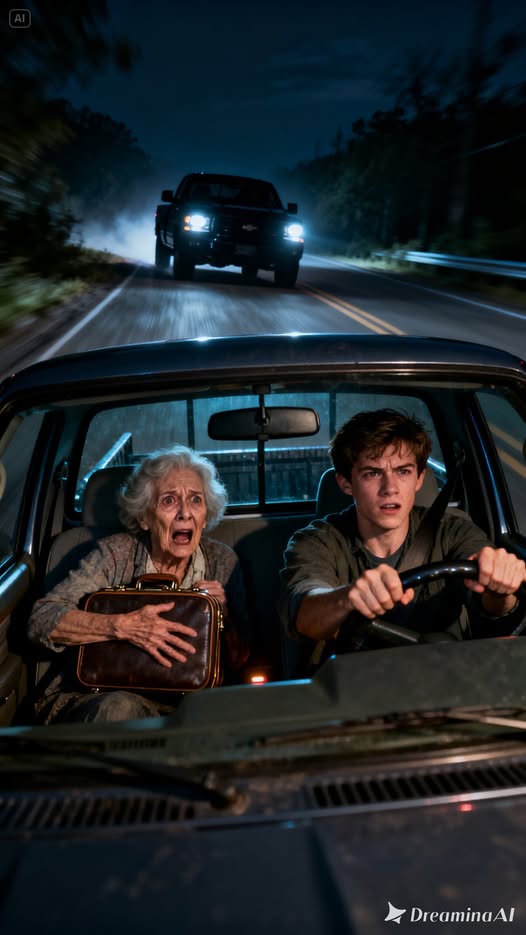
Twenty minutes later, we were in his beat-up Ford truck, speeding away from the house my late husband built with his own two hands. My phone started ringing in my purse.
Owen glanced at the screen. “Steven,” he read. “Don’t answer.”
“Why not? He’s your father. He worries.”
Owen didn’t answer. He just gripped the steering wheel harder and kept driving, his eyes fixed on the rearview mirror as if a ghost were chasing us.
My name is Claire Bennett. I am sixty-eight years old, and this is the story of how my grandson saved me from the people I birthed.
The headache had woken me before dawn again that morning. I lay still in bed, terrified to move my head. If I turned too fast, the room would tilt on its axis, sending a wave of nausea rolling through my gut. These mornings had become a cruel routine over the past two months.
I reached across the mattress. Walter’s side. Cold sheets, smooth and undisturbed. Four years now since the heart attack took him in the garden. Some mornings, in the fog of this new sickness, I still forgot he was gone.
I sat up slowly, gripping the nightstand. My hands looked skeletal in the gray light filtering through the curtains. When had I lost so much weight? The doctor said it was normal at sixty-eight. “Things slow down,” he’d said with a dismissive wave. “Your body changes.”
I made it to the bathroom and splashed cold water on my face. The woman in the mirror looked like a stranger—pale, gaunt, eyes sunken in dark hollows. I dropped another few pounds this month. My clothes hung on me like they belonged to someone else.
The kitchen was easier to navigate if I held the wall. I ran my hand along the chair rail Walter had installed thirty years ago. He’d sanded it smooth, applied three coats of varnish until it gleamed like honey. His work covered every surface in this house: the cabinets he’d built from solid oak, the built-in shelves in the living room, the banister he’d carved by hand.
Walter built this house. Not hired contractors. Him. Two years of sweat and weekends, 1982 to 1984. He came home from job sites and worked on our house until dark. Steven was two then, a toddler following his father around, trying to hold the hammer Walter gave him.
I filled the coffee pot at the sink. Through the window, I could see the maple tree Walter planted when Steven was born. It was forty-five years old now, its roots deep and unshakeable.
Two weeks ago, the ambulance came. I’d been too weak to stand. Nancy from next door found me on the bathroom floor and called 911. The hospital ran tests—blood work, scans, endless questions.
A young doctor with kind eyes pulled up a chair next to my bed. “Mrs. Bennett, your blood shows elevated carbon monoxide levels.”
I blinked at him. “What does that mean?”
“It means you’ve been exposed. Do you have a carbon monoxide detector in your home?”
“Yes,” I said. “My son checked it last month.”
“And your car? Do you run it in an attached garage?”
“The garage is detached, and I barely drive anymore.”
Steven arrived then, still in his work clothes, smelling of expensive cologne. He looked worried, his brow furrowed. He talked to the doctor in the hallway where I couldn’t hear. When he came back, he sat on the edge of my bed.
“Mom, the doctor thinks maybe you left your car running in the garage. Do you remember doing that?”
I tried to think. Had I? My memory felt like a sieve lately. “I… I don’t think so.”
“You’ve been confused, Mom. It’s okay. These things happen.”
Steven drove me home that day. He made a show of checking the detector himself. He pressed the test button. It beeped loud and clear.
“See, Mom?” he smiled, patting my hand. “It works fine. You’re safe.”
But looking at Owen’s knuckles white on the steering wheel, I realized the terrifying truth. I had never been safe.
Chapter 2: The Engineer’s Signature
Owen drove fast, but not reckless. I sat in the passenger seat with my hands folded in my lap, watching the neighborhood disappear behind us. Every house on my street held memories—forty years of birthday parties, block barbecues, and lending sugar to neighbors. Gone now in five minutes.
My small suitcase sat at my feet. I’d packed like Owen told me: clothes, medications, my toothbrush, and Walter’s photo from the nightstand. I left everything else behind.
We drove for twenty-five minutes before Owen pulled off the highway. A diner sat alone in a parking lot, one of those twenty-four-hour places with bright fluorescent lights that buzz like angry wasps.
“We need to talk,” Owen said, killing the engine. “Away from the house.”
Inside smelled like burnt coffee and bacon grease. We sat in a booth near the back. Owen ordered black coffee for both of us. He pulled out his phone and set it on the table between us like a grenade.
“Look at this,” he said, bringing up the photos again. He zoomed in on the metal box. “This is a digital timer. It’s spliced into the exhaust vent for the furnace, but there’s a diverter valve here. See this pipe?”
I nodded, though it looked like spaghetti to me.
“When the timer triggers—probably set for 2:00 AM when you’re asleep—the valve opens and redirects about thirty percent of the exhaust gas into the ductwork feeding your bedroom.”
I stared at the screen. The device looked precise. Clean. Professional.
“The vents being sealed,” Owen continued, swiping to another photo of the blocked grate behind the drywall. “That keeps the gas trapped in your room. It builds up while you sleep. Not enough to kill you in one night, but over weeks and months? It poisons you slowly. It mimics dementia. It weakens the heart.”
He looked up at me, his eyes wet. “Steven said he was helping. ‘Energy efficiency,’ right? He sealed your room into a gas chamber.”
My hand flew to my mouth. “Owen… your father knows mechanical engineering. But to do this…”
“It’s exactly how Dad would engineer something,” Owen said bitterly. “Precise. Calculated. Minimal trace. He didn’t want a sudden death that prompts an autopsy. He wanted a ‘natural causes’ death for a sixty-eight-year-old woman.”
Owen opened a browser on his phone and typed furiously. He turned the screen toward me.
APEX AEROSPACE ANNOUNCES MASSIVE LAYOFFS
The article was dated six months ago.
“Dad lost his job,” Owen said. “He never told you?”
“No,” I whispered. “He told me work was demanding.”
“He’s been lying. I found out two months ago when I stopped by his house. He was on the phone about severance packages running out. He’s broke, Grandma. Massive mortgage, two car payments, country club fees. They are drowning.”
My stomach turned. “Your house… Walter’s house… it’s worth…”
“Eight hundred thousand,” Owen finished. “You own it outright. If you die, the estate splits. Dad and Aunt Jessica get four hundred grand each. Immediate cash injection.”
“Jessica?” I asked, a new wave of horror washing over me. “Surely not Jessica.”
“Uncle Paul has kidney disease,” Owen said quietly. “You know that.”
“Yes. But they have insurance.”
“Not for the experimental treatments he needs. Jessica told me at Christmas they were looking at three thousand a month out of pocket. She was crying in the kitchen.”
The diner felt suddenly freezing. My daughter worked in insurance claims. She knew exactly how death investigations worked. She knew what looked suspicious and what looked like a tired old woman’s heart giving out.
“Mom’s in real estate,” Owen added, speaking of his mother, Kelly. “She knows the market. She knows how fast she could flip your house.”
The truth sat heavy between us, uglier than the grease stains on the table. My daughter helped plan the logistics. My son engineered the weapon. My daughter-in-law calculated the profit.
My phone buzzed again. Owen snatched it up.
“Eight missed calls from Dad,” he said. “Five from Aunt Jessica. They know I’m gone. They know something’s wrong.”
He handed me the phone. “Don’t answer yet.”
I stared at the list. Steven’s name, over and over. My baby boy. The one who used to run to me when he scraped his knee. Now he was trying to scrape me out of existence.
Owen stood up. “I’m taking you to a hotel. One where they can’t find us. I need to upload these photos to a cloud server. If Dad figures out I have evidence, he’ll come for me.”
“Do it,” I said.
As we walked out to the truck, I looked at my grandson. He wore Walter’s old tool belt. He had Walter’s walk. He had Walter’s heart.
“Your grandfather would be so proud of you,” I said, squeezing his arm.
“I know,” he said, his voice hard. “And he’d be ashamed of them.”
We pulled onto the highway. I watched the diner disappear in the side mirror, feeling like I was leaving my entire life behind.
Chapter 3: The Cornered Rats
The hotel was small and plain, the kind of place where truckers slept for a few hours before moving on. Owen paid cash for room 214.
“Try to sleep,” he said, sitting in the single chair by the window, watching the parking lot.
I lay on the bed, staring at the water stain on the ceiling. Every sound made me jump. Footsteps in the hall. The ice machine rumbling. I realized with a jolt that I was afraid of my own children. Not strangers. Not burglars. But the babies I had nursed and rocked.
The sun came up gray and cold. Owen hadn’t slept.
“I need to go back,” he said suddenly.
“What? No!”
“Your symptom notebook,” he said. “The one you kept by your bed. We left it. That notebook proves the timeline. It proves your symptoms match the dates he did the work.”
“It’s too dangerous,” I pleaded.
“I’ll be fast. In and out. Lock the door behind me.”
He left before I could stop him. I locked the door, put the chain on, and sat on the bed, counting the seconds.
Forty-five minutes later, a knock.
“It’s me.”
I opened the door. Owen burst in, pale and sweating, clutching my blue spiral notebook.
“They were there,” he gasped, locking the door and dragging the chair under the handle. “Dad and Mom. I hid by the garage.”
“What did you hear?”
“Dad was on the phone. He said, ‘Owen has her. If the police see this house, we’re done. We need to find them now.’ Then Mom said she was calling every hotel in a fifty-mile radius.”
My chest tightened. “They’re hunting us.”
“Dad said something else,” Owen said, looking at me with wide eyes. “He said, ‘We’re too far in. We have to finish this.’”
The phone on the nightstand rang.
We both froze. It was the hotel landline.
It rang four times. Then stopped.
Thirty seconds later, my cell phone rang. Jessica.
“They found us,” Owen whispered. “Mom must have used her real name calling hotels.”
He ran to the window and peeked through the curtain gap. He stiffened.
“Dad’s car is in the lot,” he said. “And Aunt Jessica’s SUV.”
“Oh God,” I whimpered. “What do we do?”
Owen pulled out his phone. He dialed 911.
“My name is Owen Bennett. I’m at the Sleep Inn on Route 42. My father and aunt are here. They’re trying to hurt my grandmother. We have evidence of attempted murder. Send help.”
He left the line open and shoved the phone in his pocket.
A knock at the door. Gentle.
“Mom?” It was Steven. “Mom, I know you’re in there. Open the door. Please. We just want to talk.”
Owen grabbed my arm and pulled me toward the bathroom. “The emergency exit,” he whispered. “Through the back.”
We crept through the connecting door into the maintenance hallway.
“Mom!” Steven’s voice turned angry. “Open this door right now!” A heavy thud shook the wall. He was kicking it.
We ran. Down the concrete stairs, bursting out into the alley behind the hotel. The cold air hit my face.
We sprinted toward Owen’s truck at the far end of the lot.
“Going somewhere?”
We skidded to a halt. Jessica stood at the end of the alley, blocking our path to the truck. She looked tired, her hair messy, but her eyes were cold.
We turned around. Kelly stood at the other end.
And from the side door of the hotel, Steven emerged, holding a tire iron.
We were trapped.
“Mom, stop this,” Steven said, walking slowly toward us. “You’re confused. The carbon monoxide… it affected your brain. You’re paranoid.”
“I found the device, Dad,” Owen shouted, stepping in front of me. “I have photos. The timer. The vents.”
“You photographed a heating system!” Steven yelled, his calm mask slipping. “You don’t understand engineering!”
“I understand murder!” Owen yelled back.
“You don’t understand survival!” Steven roared. “I am losing everything! Twenty years, and they cut me loose like garbage! I have three months of money left. We are about to lose the house!”
“So you kill your mother?” I asked, my voice trembling but loud. “For four hundred thousand dollars?”
“You’ve lived your life!” Kelly shouted from behind us. “You’re sixty-eight! You have an eight-hundred-thousand-dollar house sitting there while we drown! It’s not fair!”
“Fair?” I looked at the woman I had welcomed into my family. “You think murder is fair?”
Jessica stepped closer, reaching into her coat pocket. She pulled out a syringe.
“It’s just a sedative, Mom,” she said, her voice shaking. “To calm you down. You’re agitated. We’ll take you home. You’ll go to sleep. It will be peaceful.”
“Stay back!” Owen warned.
Steven raised the tire iron. “Move, Owen. This doesn’t concern you.”
“She is my grandmother!”
“She is my mother!” Steven screamed. “And I am doing what I have to do!”
“You’re doing what a coward does,” Owen spat. “Grandpa would be ashamed of you. You took his tools, his house, and turned them into a weapon.”
“Don’t talk to me about him!” Steven swung the tire iron.
Owen ducked. The iron clanged against the dumpster. Owen lunged, tackling his father. They hit the pavement hard. The tire iron skittered away.
“Owen!” I screamed.
Jessica ran at me with the syringe.
I backed against the brick wall. “Jessica, please!”
“I’m sorry, Mom,” she wept, raising the needle. “We can’t go to jail.”
Sirens wiled.
Two police cruisers screeched into the alley, boxing them in. Doors flew open.
“POLICE! DROP IT!”
Jessica froze. The syringe fell from her hand and shattered.
Steven pushed Owen off and scrambled up, but he was staring down the barrel of a Glock.
“Hands! Let me see your hands!”
It was over.
Chapter 4: The Legacy
The police station smelled of stale coffee and bleach. Detective Morris took our statements. Owen showed her everything—the photos, the notebook, the 911 recording that had captured their entire confession in the alley.
They executed search warrants that afternoon. They found Steven’s “Project Timeline” on his computer—a cold, calculated plan for my demise. They found Jessica’s research on elderly autopsies. They found Kelly’s burner phone texts.
Steven got fifteen years. Kelly got twelve. Jessica got ten.
At the sentencing, I stood up and told the court about Walter. About how he built things to last. About how he built things to protect.
“My son used his engineering degree to pervert that work,” I said, looking Steven in the eye. He looked away. “But my grandson saved me using his grandfather’s values. That is the true legacy.”
Six months later, I sold the house. I couldn’t live there anymore. Every room held a ghost of betrayal.
I watched as the new owners, a young couple, walked through the door. They would repaint. They would fill it with new memories. They would never know about the poison in the walls.
Owen helped me move into a small apartment across town. He installed Walter’s oak kitchen cabinets for me—he had saved them before the house was sold.
“Grandpa said these would outlast us,” Owen said, running his hand over the smooth wood.
“They did,” I smiled. “And so did we.”
One Thursday evening, Owen came for dinner. He brought a girl with him. Sarah. She was an artist with paint under her nails and a warm smile.
“Owen talks about his grandfather constantly,” she told me as we ate. “He says Walter was the best man he ever knew.”
“He was,” I said, looking at my grandson. “But I think he has some competition.”
After dinner, I watched them wash dishes together at the sink. They laughed, bumping shoulders. It was simple. It was normal. It was the kind of life that goes on after the world ends.
I stood in my small kitchen, listening to the hum of the refrigerator. I touched the cabinet Walter had built.
“You protected us, Walter,” I whispered to the empty room. “You built a house. But you also built a grandson.”
The morning sun would come through the window tomorrow. It would warm the wood. It would light up the room.
Some things break. Some things rot from the inside out. But some things? Some things are built to last.
I smiled and went to bed, finally at peace.