
Ideology placed him at the center of a broader ideological debate unfolding far beyond City Hall. Just hours before his first formal meeting with former President..
Donald Trump in Washington, the U.S. House of Representatives passed a bipartisan resolution condemning what it described as the “horrors of socialism.”
Though symbolic and nonbinding, the resolution’s timing drew immediate notice, coming at a moment when one of the most prominent democratic socialists in American politics was preparing to lead the nation’s largest city.
The vote reflected a growing tension between national lawmakers and the increasingly progressive direction of New York City’s politics.

While Republicans framed the resolution as a moral and ideological reaffirmation of capitalism and liberal democracy, its passage also highlighted internal divisions within the Democratic Party.
For many observers, the episode underscored how ideological debates that once felt abstract have become closely tied to real governance, particularly in major urban centers.
The resolution passed the House with a 285–98 margin, with support from both parties, including 86 Democrats.
Though it carried no legal force, the measure was designed to send a political message.
Republicans argued it was necessary to formally reject socialism as incompatible with American values, while critics saw it as a performative gesture aimed at energizing voters and drawing sharp ideological contrasts ahead of future elections.
Several high-profile Democrats supported the resolution, including House Minority Leader Hakeem Jeffries of New York.
Other New York Democrats who voted in favor included Ritchie Torres, Greg Meeks, Grace Meng, Laura Gillen, and Tom Suozzi.
Their support reflected a more centrist or establishment wing of the party that has often clashed with the city’s growing democratic socialist movement.
Suozzi, in particular, had previously distanced himself from Mamdani during the mayoral campaign, publicly signaling concerns about ideological rigidity and fiscal policy.
His vote was widely interpreted as a continuation of that stance, highlighting the ideological gap between traditional Democrats and the younger, more left-leaning coalition that propelled Mamdani to victory.

For many centrist Democrats, the rise of democratic socialism within urban politics presents both an opportunity to energize voters and a risk of alienating moderates.
Republican supporters of the resolution framed their arguments in moral, historical, and personal terms. Representative Nicole Malliotakis of New York cited her family’s history, referencing her mother’s flight from Cuba as evidence of socialism’s failures.
Other Republicans echoed similar narratives, emphasizing experiences of authoritarianism, economic collapse, and repression in countries that identified as socialist.
They argued that condemning socialism was not merely ideological theater, but a reaffirmation of democratic capitalism as the foundation of American prosperity and freedom.
Progressive Democrats strongly objected to the measure. Representative Maxine Waters and others criticized Republicans for focusing on ideological declarations rather than addressing economic pressures faced by American families, such as housing costs, healthcare access, and wage stagnation.
They argued that the resolution blurred distinctions between authoritarian socialism and democratic socialist policies commonly advocated in the United States, such as expanded social programs, worker protections, and public investment.
Mamdani himself dismissed the resolution as largely irrelevant to his work as mayor-elect. In public statements, he emphasized that his focus remained on governing New York City and delivering practical solutions to everyday problems.
Rather than engaging in ideological sparring with Congress, Mamdani reiterated his commitment to making the city more affordable, improving public services, and addressing inequality.
While acknowledging ideological differences with national leaders, Mamdani stressed cooperation and pragmatism.
He described democratic socialism not as a rigid doctrine, but as a civic philosophy centered on ensuring that government works effectively for ordinary people.

His approach, he said, would be defined by outcomes rather than labels, with a focus on housing affordability, transportation, education, and public safety.
The contrast between the House vote and Mamdani’s messaging highlighted a central tension in contemporary American politics: the gap between symbolic ideological battles and the practical demands of governance.
While lawmakers in Washington debated the meaning of socialism in broad terms, Mamdani faced the immediate realities of running a city of more than eight million people, managing budgets, infrastructure, and services that affect daily life.
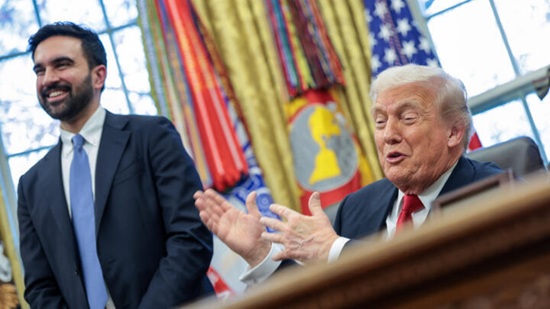
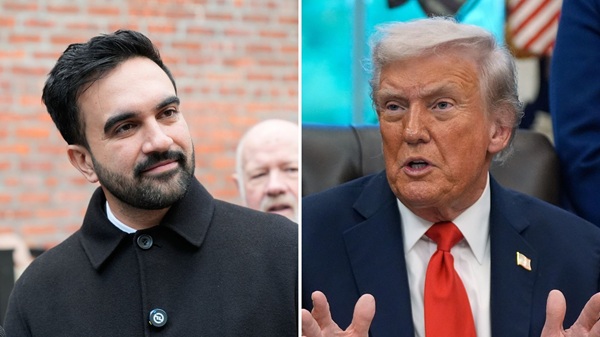
Adding to the political complexity of the week was Mamdani’s meeting with former President Donald Trump. The encounter carried symbolic weight, given the history of public hostility between the two figures.
During the mayoral campaign, Trump had criticized Mamdani sharply, while Mamdani had positioned himself as a vocal critic of Trump’s policies and rhetoric.
Despite expectations of confrontation, reports indicated that the meeting was cordial and, at times, even light-hearted.
Sources familiar with the discussion described a pragmatic exchange focused on federal-city relations, infrastructure funding, and public safety concerns.
Trump reportedly expressed a sense of comfort with New York City following the conversation, signaling a softened tone toward the incoming mayor.
Trump’s comments suggested a willingness to engage constructively, even across deep ideological differences.
For Mamdani, the meeting represented an opportunity to demonstrate that democratic socialist leadership at the city level could coexist with cooperation at the federal level. For Trump, it offered a chance to present himself as open to dialogue while maintaining ideological distinctions.
The juxtaposition of these events—the House resolution condemning socialism, Mamdani’s dismissal of its significance, and a surprisingly civil meeting with Trump—illustrated the layered nature of modern American politics.
Ideological debates continue to dominate headlines, yet governance often requires flexibility, negotiation, and personal diplomacy.
Political analysts noted that the House vote was less about Mamdani personally and more about broader national messaging. Democratic socialism has gained visibility in recent years, particularly in urban areas and among younger voters.
Figures like Mamdani symbolize that shift, challenging long-held assumptions about what political identities are viable in American leadership roles.
At the same time, the response from centrist Democrats and Republicans underscores the limits of that shift. Many lawmakers remain cautious about embracing the socialist label, even when supporting policies that align with progressive goals.
This tension reflects ongoing debates within the Democratic Party about strategy, messaging, and the balance between ideological clarity and electoral pragmatism.
For New York City, the focus now turns to Mamdani’s transition into office. Expectations are high, and scrutiny remains intense.
Supporters view his election as a mandate for bold change, while critics warn of fiscal risks and ideological overreach.
How Mamdani governs—how he balances ideals with administrative realities—will shape perceptions not only of his leadership, but of democratic socialism’s viability in American municipal governance.
Mamdani has repeatedly emphasized that his administration will be results-driven. He has highlighted plans to expand affordable housing, strengthen tenant protections, invest in public transit, and improve city services.
He has also stressed the importance of working with state and federal partners, regardless of political affiliation, to secure resources for the city.
The broader national reaction to his election and early actions suggests that New York City remains a political bellwether.
Decisions made at City Hall often resonate far beyond city limits, influencing debates about urban policy, economic inequality, and the role of government in American life.
Mamdani’s leadership will likely serve as a case study for both supporters and critics of progressive governance.
The week’s events demonstrated how ideological symbolism and practical politics intersect. A congressional resolution formally denouncing socialism coexisted with behind-the-scenes cooperation between political opponents.
Rhetoric clashed with pragmatism, and national narratives collided with local priorities.
In many ways, the situation reflects the evolving nature of American democracy. Ideological lines are sharper, yet governance increasingly depends on dialogue across those lines.
Public officials navigate a landscape where symbolic gestures carry weight, but tangible outcomes ultimately define success.
As Zohran Mamdani prepares to take office, he does so amid both resistance and opportunity. His challenge will be to move beyond labels and demonstrate that his vision can translate into effective governance for New York City.
The national spotlight may intensify debates, but it also offers a platform to redefine what democratic socialism looks like in practice.
Ultimately, the events surrounding the House resolution, Mamdani’s response, and his meeting with Trump underscore a central truth of contemporary politics: ideology shapes perception, but governance shapes reality.
How those forces interact will determine not only the trajectory of New York City, but also the broader conversation about the future of American political life.