
Heavy snow slammed relentlessly against the windows of the old Montana farmhouse, turning the outside world into a white, unbroken blur.
The wind whistled and howled around the eaves, rattling loose shingles and carrying with it the mournful echoes of the frozen valley.
Icicles hung like jagged glass along the roofline, and snowdrifts pressed against the walls, making the house seem even smaller and more isolated.
Inside, seventy-eight-year-old Agnes Porter sat quietly in her favorite armchair, a steaming cup of chamomile tea warming her hands.
The porcelain mug felt heavy, almost grounding, as she inhaled its calming aroma.
Her life had been marked by decades of fierce Montana winters, of snowdrifts taller than fences and nights so dark that the stars seemed swallowed whole.
She had grown accustomed to solitude, and the stillness of her home had always been a comfort—a cocoon against the harshness of the storm.
The ticking of the old grandfather clock in the hallway and the crackle of the wood-burning stove created a rhythm she had learned to trust, a small measure of peace in a world that often seemed unforgiving.
But on this particular night, the comforting rhythm of her routine was shattered.
At first, she noticed a faint glow through the blizzard, a distant set of headlights struggling to pierce the swirling snow.
Agnes assumed it was a lone traveler, perhaps someone foolish enough to brave the closed mountain roads.
She had heard stories of drivers stranded for hours, sometimes days, in storms like this. Then came a second pair of lights.
And as the vibrations beneath her floorboards grew stronger, her assumptions faltered.
Fifteen motorcycles emerged through the storm, their engines growling like a pack of wolves, filling her driveway with a thunderous roar that made the wooden house tremble.
The riders dismounted with practiced ease, leather-clad and imposing, their jackets adorned with patches she recognized from whispered town gossip: The Night Nomads.
Each man moved like he had seen and survived more than most could imagine, yet the snow clung to their boots, dripping and melting on the porch boards.
Agnes froze in the doorway, her heart pounding. The stories had always painted them as troublemakers—fighters, drifters, men whose reputations preceded them like smoke.
Yet as she studied the group through the snow-blurred window, she saw more than their fearsome exterior.
She saw shivering men, shoulders hunched against the wind, the biting cold painting their cheeks red and hands raw.
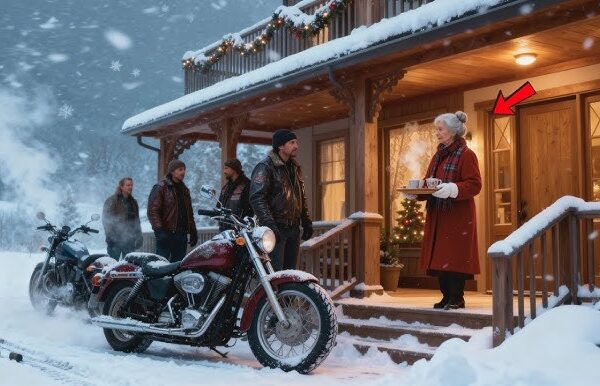
Fear clawed at her chest, but so did something else: a memory of decades past, when she and her late husband James had been stranded in a blizzard until a stranger had opened their door and saved them.
James had always said fear should never dictate kindness.
The first three knocks on the door cracked sharply through the wind.
“Who is it?” Agnes called, her voice betraying a tremor she tried to hide.
A deep, steady voice answered, muffled by the howling storm. “Ma’am… we don’t want trouble. Roads are shut down, and we’re freezing out here. Could we… come in?”
Desperation hung in the words, and it softened something in Agnes.
She hesitated only a heartbeat before her hand shook as she unlatched the door.
Snow gusted inside, swirling around her boots and melting on the wooden floorboards, as fifteen towering figures stepped into her home.
The leader, a man whose scarf fell away to reveal a rugged, weathered face lined with years on the road, extended a hand.
“Name’s Jack,” he said, his voice rough but calm. “We just need shelter for the night.”
Agnes’s eyes swept over him and the men behind him. Patches, scars, leather worn to the point of glossing—every detail screamed danger.
Yet something in the way they shivered, the way they clutched themselves against the cold, made them seem less like outlaws and more like men caught in circumstances far beyond their control.
“Come in before you all freeze to death,” she said, stepping aside.
The farmhouse filled with the smell of wet leather and winter wool. Snow clung to their boots and jackets, steam rising as the men removed layers to warm themselves by the fire.
Agnes hurried to fetch blankets from her cedar chest, hands trembling, heart racing.
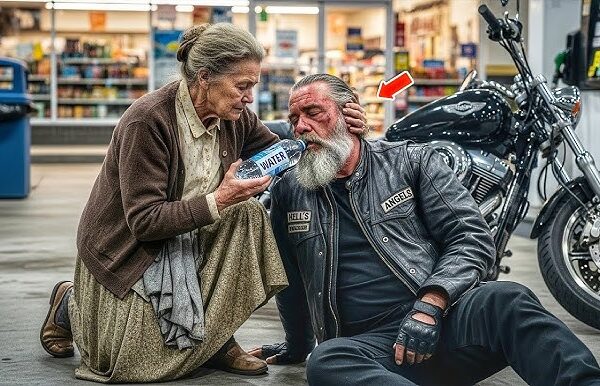
One young biker—Luke, she later learned—pulled off his gloves to reveal fingers swollen, mottled, and dangerously red from frostbite.
Without hesitation, she wrapped a thick wool blanket around him, muttering softly about circulation and warmth.
The room fell quiet. Fifteen grown men, rough and unpolished, stared at her like she had just performed a miracle.
Jack stepped forward, lowering his gaze respectfully. “We’ll behave, ma’am. You have my word,” he said.
Agnes nodded, still unsure if she’d made the right choice, but the sharp edge of her fear had softened. One by one, they settled around the room.
Jackets were hung over chairs; boots were removed carefully to avoid sloshing snow across the floorboards.
The crackling fire filled the space with warmth, and soon Agnes was brewing a pot of her strongest tea, handing steaming mugs to each of the men.
Their thanks were quiet, hesitant, almost embarrassed—a sound of people unused to care rather than confrontation.
Outside, the storm raged, but inside the farmhouse, a fragile peace had taken hold. One biker pulled out a beat-up guitar and strummed soft chords, blending with the fire’s crackle.
The group ate the humble stew Agnes had cobbled together—potatoes, beans, and a bit of leftover roast—and treated it like a banquet, laughter spilling into the room like sunlight.
Jack watched the fire in silence for a long while before speaking. “You remind me of my grandmother,” he said quietly.
Agnes raised an eyebrow. “Is that so?”
“She’d box my ears if she knew half the things I’ve done,” he continued with a faint smile. “Lost her to cancer years back.”
Agnes felt the familiar ache of shared grief, the kind that recognizes itself in another’s eyes. For a fleeting moment, the outlaw and the old widow were just two people, each with a chair forever empty at their table.
By midnight, the bikers were spread across the living room, sleeping wherever they could find space.
Agnes lay awake in her bed, listening to their even, heavy breathing and the soft creaks of the house against the storm.
Doubt crept in—was she foolish to trust them? But alongside the worry came a gentler thought: perhaps kindness was stronger than fear.
The storm outside grew fiercer, snow piling higher against the windows, yet inside, the farmhouse was filled with warmth, the scent of pine logs, and a sense of quiet safety.
The bikers had removed their leather jackets, revealing worn flannels, faded T-shirts, and scarred arms—details Agnes hadn’t noticed at first.
There was humanity behind every patch, every tattoo, every rough exterior.
At dawn, the engines rumbled again. Alarm shot through her chest. Rushing to the window, she watched as the men lined up their motorcycles, careful not to wake her.
Jack lifted his hand in a quiet salute. No noise, no threats, just gratitude etched on his worn face.
Later, in the town’s general store, she could feel the whispers and stares. “You let them in?” “Agnes Porter could’ve been killed.” “Reckless.”
She ignored them. But when the sheriff came to her door that evening, concern etched into his face, she finally let herself respond.
“Agnes,” he said, voice low but tense, “folks think you’re putting yourself in danger.”
“They needed shelter,” she shot back, heat rising. “In a storm that could have killed them. That’s all.”
“The boys… trouble follows them,” he warned.
“Kindness follows me,” she countered. “And that’s the choice I made.”
He left unconvinced, but later, as Agnes tended her fire and looked at the blanket she had draped around Luke, she knew her decision had come from a deeper place than fear or gossip.
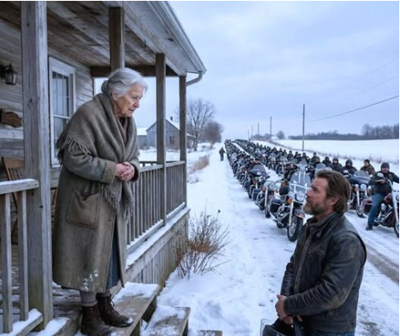
Then, later that day, headlights appeared again. Not one or two—but a hundred motorcycles, lining her long driveway in perfect formation. Engines hummed like distant thunder. Jack stepped forward.
“You opened your door when no one else would,” he said. “Word travels. We don’t forget.”
One by one, they approached her porch, leaving behind tokens of loyalty—bandanas, patches, gloves. Luke handed her a patch of his own, quietly, reverently.
“For you,” he said. “So you know you’ve got family on the road.”
Agnes felt tears sting her cheeks. “All I did was give you warmth,” she whispered.
Jack shook his head, firm but gentle. “You gave us dignity. That matters more.”
The bikers stayed for hours, shoveling snow from her driveway, stacking firewood, repairing a sagging fence—silent acts of repayment, untainted by gossip or fear.
Then, as the sun finally climbed over the Montana peaks, they rode off in a single, thunderous line, leaving Agnes on her porch with a heart full in a way it hadn’t been in decades.
She had offered compassion in a storm, and it had returned to her in an avalanche of loyalty.
In a world quick to fear what it did not understand, Agnes had chosen differently.
And whenever she looked at the patched fence, the stacked firewood, or the wool blanket she had wrapped around Luke, she smiled softly, remembering that sometimes the world doesn’t need silence to listen—it just needs someone brave enough to open the door.