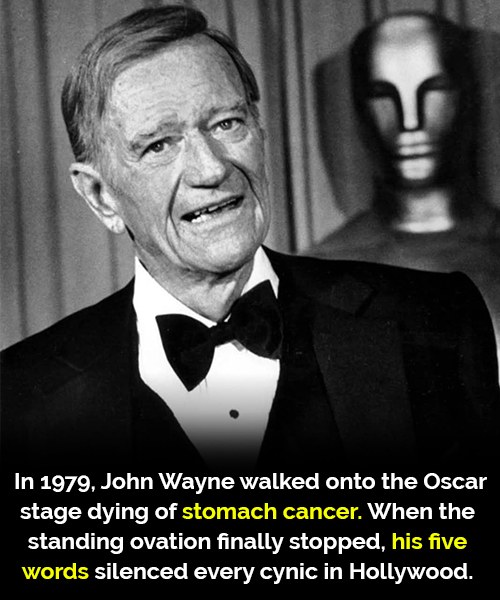
When the lights dimmed inside the Dorothy Chandler Pavilion on April 9, 1979, a hush fell over Hollywood — not the polite quiet that precedes an awards segment, but a deep, collective silence filled with nostalgia, reverence, and a hint of fear.
Every person in that grand room, from up-and-coming actors to the most seasoned legends, sensed that they were about to witness something unforgettable.
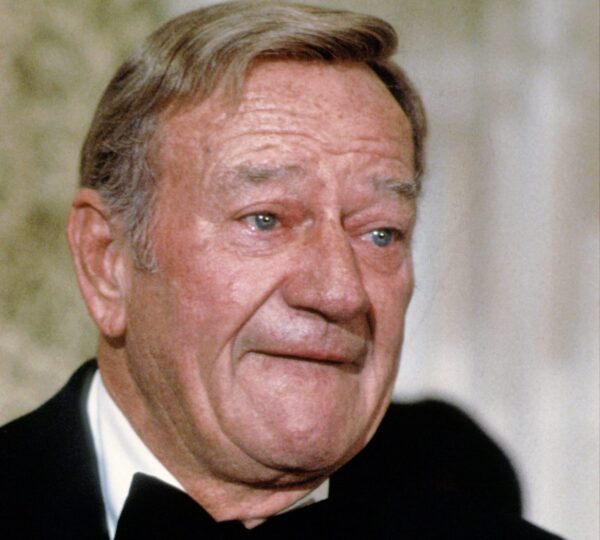
Because behind the curtain, gathering his strength and steadying his breath, stood John Wayne — the man who had embodied American heroism on screen for more than fifty years.
A man who had survived studio battles, box-office wars, political storms, and real medical struggles. Yet on that evening, he was facing the toughest challenge of all.
A Night That Became a Final Chapter
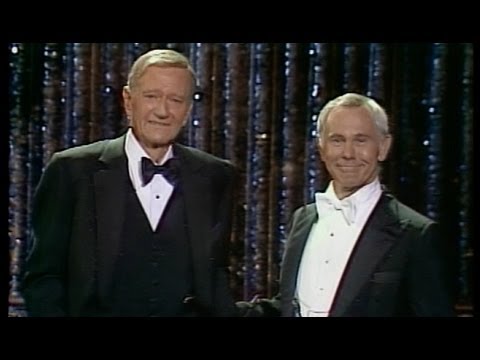
The 1979 Academy Awards were memorable for many reasons. Johnny Carson’s humor was effortless, floating through the auditorium with his famous dry charm.
Acceptance speeches were brief but heartfelt. The major awards went to two Vietnam War films — The Deer Hunter and Coming Home — capturing a nation still wrestling with the wounds of conflict.
But none of that was the heart of the evening.
The emotional gravity of the ceremony centered on John Wayne, affectionately known as “The Duke.”
There was no special announcement, no buildup. But the industry knew.
Hollywood always knows.
Only a small circle understood the full truth of how fragile Wayne had become.
To everyone else, the rumors were enough to stir worry.
A Cancer Diagnosis That Shook Hollywood
In January 1979, Wayne had undergone what was expected to be a simple gallbladder operation.
Instead, his surgeons discovered advanced stomach cancer — a devastating surprise for a man already battered by years of health battles.
The operation stretched into nine and a half hours.
His entire stomach had to be removed.
It was a shocking revelation, especially because Wayne had already survived one brutal fight: lung cancer in 1964, which cost him a lung and several ribs.
And in 1978, he underwent open-heart surgery to replace a valve, forcing him to miss the Oscars entirely that year.
At seventy-two, weakened and struggling to rebuild his strength, many wondered whether he would ever appear in public again.
Then Bob Hope called — not as a comedian, but as a friend.
He personally asked Wayne to present at the Oscars.
And Wayne, even in pain, even knowing the risks, answered the only way he knew how:
He said yes.
A Frail Legend Walks Into the Spotlight
Inside the auditorium, the atmosphere shifted the moment Wayne appeared at the top of the staircase. People stopped mid-breath.
His gait was slower, his body thinner, his frame more fragile. Yet he carried himself with the unmistakable presence of “The Duke” — that steady, commanding confidence that had defined him since the silent films of the 1920s.
His skin was tanned, his smile warm, his posture proud.
The audience rose instantly, not out of routine, but out of profound love and admiration.
It wasn’t a standing ovation.
It was a farewell salute.
The applause grew louder, swelling through the auditorium like a wave of gratitude.
People clapped not just for his films, or his characters, or his iconic drawl — but for the man who had survived so much and still had the courage to walk onto that stage.
Many in the room had tears in their eyes before he even spoke.
“That’s just about the only medicine a fellow would ever really need.”
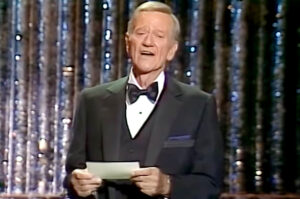
When the applause finally faded into a reverent silence, Wayne delivered his opening line — a line that felt both humble and heroic.
“Thank you, ladies and gentlemen,” he said softly, but firmly.
“That’s just about the only medicine a fellow would ever really need.”
In that moment, Hollywood cried.
Then, blending humor with bravery, he added:
“Believe me when I tell you that I’m mighty pleased that I can amble down here tonight.
Well, Oscar and I have something in common. Oscar first came to the Hollywood scene in 1928.
So did I. We’re both a little weather-beaten, but we’re still here and plan to be around for a whole lot longer.”
The audience laughed, cried harder, and understood exactly what he meant.
He was fighting — fiercely — for more time.
Announcing the Year’s Best Picture — and His Final Appearance
Wayne proceeded to present the nominees for Best Picture:
- The Deer Hunter
- Coming Home
- Midnight Express
- An Unmarried Woman
- Heaven Can Wait
When he announced The Deer Hunter as the winner, applause thundered through the hall.
The producers took the stage to accept the award, and Wayne stepped back, surrounded by industry friends who had known him from Hollywood’s earliest days.
No one realized that this would be John Wayne’s final public appearance.
It felt momentous, but no one knew how close he was to the end.
The Final Weeks of a Giant
Eleven days later, on April 20, Wayne was admitted to UCLA Medical Center with a bronchial condition. He was discharged after a week, but his health continued to deteriorate.
On May 26, his 72nd birthday, he received the Congressional Gold Medal, one of the nation’s highest honors.
Just sixteen days later — on June 11, 1979 — John Wayne died at UCLA Medical Center.
In his final months, he had volunteered for an experimental cancer vaccine trial. He told his doctors:
“If this is helpful, I’m going to help you afterward.”
Even facing death, he thought of others.
A Secret Grave and a Lasting Legacy
John Wayne was buried at Pacific View Memorial Park in Newport Beach, California. The spot overlooked the ocean — peaceful, beautiful, fitting.
But for decades, no one knew exactly where.
According to the Los Angeles Times, his grave remained unmarked for twenty years. His funeral was kept private, guarded from the public eye. Fans were locked out.
The ceremony was intimate and quiet — the opposite of the larger-than-life figure he had presented to the world.
It wasn’t until the late 1990s that his grave finally received a permanent marker.
Today, the John Wayne Cancer Institute stands as part of his enduring legacy — a place dedicated to research, hope, and the fight against the disease that ultimately took him.
The Lasting Image
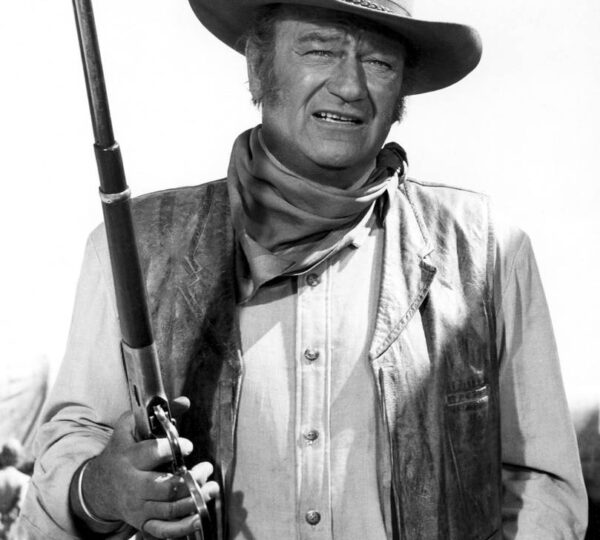
For many people, the image that remains most vivid is not from True Grit, The Searchers, or Stagecoach.
It is from the 1979 Oscars:
A fragile man descending a staircase with the courage of a giant.
A legend smiling through pain.
A room full of colleagues rising to their feet to honor him.
A final bow from a man who had given Hollywood, and the world, a lifetime of unforgettable moments.
John Wayne’s farewell was not dramatic or scripted — it was real, raw, and deeply human.
A last act defined by:
Courage.
Dignity.
Grace.