
George Strait, long regarded as one of country music’s most steady and enduring pillars, was among the honorees at the 48th Annual Kennedy Center Honors.
A cultural institution that annually recognizes lifetime achievement in the arts.
At this year’s event, held in early December at the John F. Kennedy Center for the Performing Arts in Washington, D.C., Strait joined a class that also included Sylvester Stallone, Gloria Gaynor, KISS, and Michael Crawford — a roster that spanned country, rock, film, disco, and Broadway.
The ceremony was notable not only for its celebration of artistic legacy but also because a sitting president took on duties normally performed by a host separate from political office.
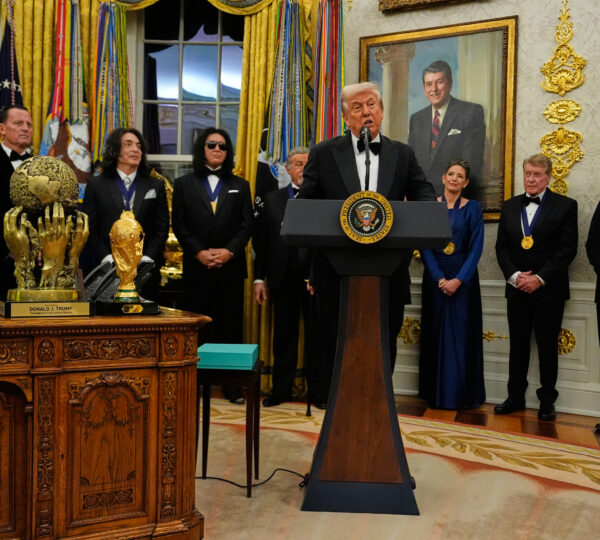
President Donald Trump served as host and chairman of the Kennedy Center board for the first time, presenting the honorees and celebrating their impact on American culture.
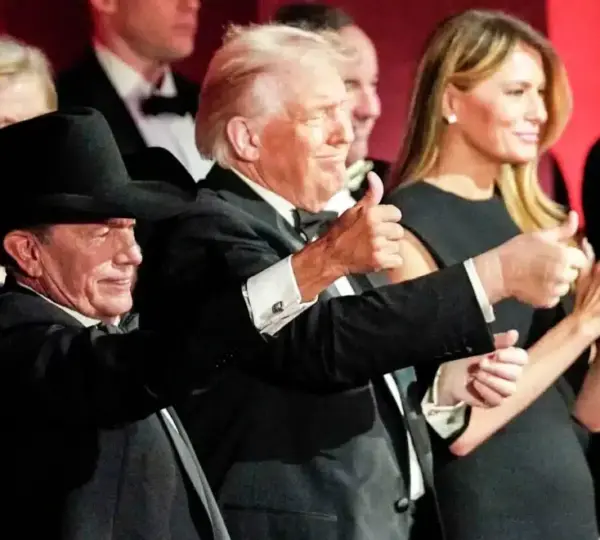
It was in that context — amid performers, tributes, and televised remembrance of long careers — that an unremarkable moment quietly stood out: George Strait appeared seated beside President Trump in the audience.
There was no formal introduction on camera, no deliberate spotlight, and no staged exchange intended for the broadcast.
Instead, the image of such different cultural figures sitting side by side passed subtly through the ceremony — unannounced, unremarked upon by hosts, and unaccompanied by commentary or explanation.
The moment’s resonance came not from flash or spectacle but from a kind of quiet coexistence that viewers noticed precisely because it was so unembellished.
For decades, George Strait’s career has been built on durability rather than provocation and tradition rather than spectacle. Often called the “King of Country Music,” he emerged in the early 1980s with a straight‑ahead sound rooted in honky‑tonk, Western swing, and classic country storytelling.
His approach has leaned on emotional clarity, professional consistency, and an aversion to headlines beyond his work onstage.
In a career that has yielded numerous No. 1 hits, record‑breaking audiences, and a place in the Country Music Hall of Fame, Strait has rarely chased controversy or public attention outside his music.
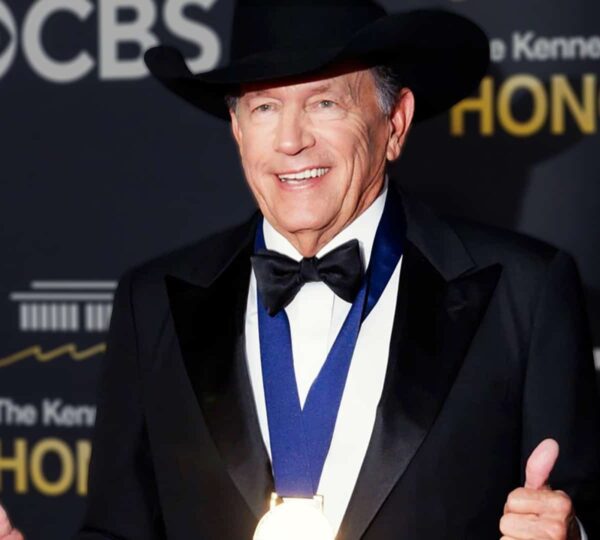
At the Kennedy Center Honors, he looked exactly as audiences expect him to look: attentive, composed, and content to let the limelight fall on peers and the broader art being celebrated rather than on himself alone.
In contrast, President Trump’s involvement in the ceremony carried a distinctly different kind of gravity — one shaped as much by politics as by cultural recognition.
Traditionally, a sitting president will attend the Honors but does not host or preside over them in a manner that dominates the event.
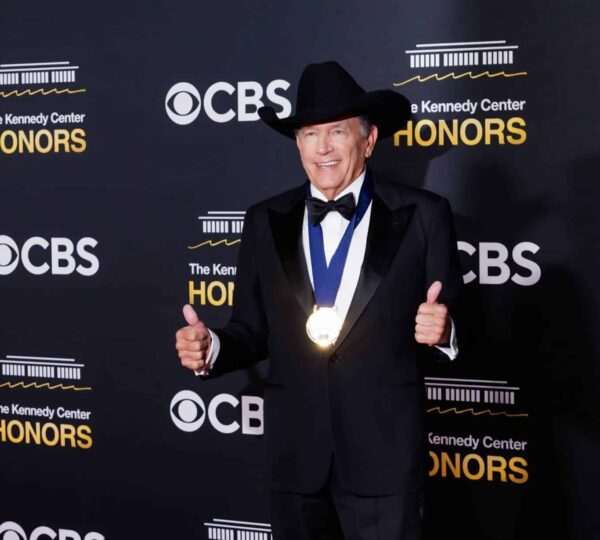
In 2025, however, Trump did more — he actively hosted the ceremony and led the presentation of medals, breaking with precedent and intertwining the awards with his own public identity.
CBS and Paramount+ aired the event in late December, with Trump’s involvement highlighted both onstage and in pre‑recorded segments.
No matter one’s political view, Trump’s presence tends to alter the atmosphere of any cultural setting. His name, actions, and rhetoric are politically charged in ways that command attention long before he speaks a word or makes a gesture.
Yet on this evening, that tension was not overtly on display in the Kennedy Center’s grand foyer or its ornate concert halls.
The Honors are structured not as political rallies but as celebrations of collective achievement. Across the course of the night, performances, speeches, and recorded tributes reflected decades of influence and craft, inviting audiences to focus on the honorees’ contributions to the cultural fabric of the nation.
Music filled the hall; artists and peers shared stories of inspiration; viewers saw footage of past performances and career milestones. The audience responded with sustained attention — applause, thoughtful listening, and the kind of respect the ceremony traditionally evokes.
It was against this backdrop that the image of Strait and Trump together became meaningful — not because it demanded interpretation, but because it resisted one.
There was no obvious symbolism attached to their seating arrangement, no overt acknowledgement from speakers onstage, no deliberate camera focus.
Yet for viewers and commentators alike, the visual of a country music legend and a politically divisive sitting president sharing a balcony seat instantly sparked reflection about contrasting worlds: the world of artistic legacy and the world of political identity.
One reason this image resonated was restraint. In an era where so many public moments are crafted for virality or designed to provoke commentary, this moment felt almost anti‑performative. No one onstage mentioned the seating.
The broadcast cameras did not linger. It was treated as incidental rather than instructive — and in that treatment, it became noticeable precisely because it didn’t demand interpretation or force a narrative onto the audience.
In an age of social media rumination and instantaneous analysis, such restraint can be striking in its own right.
The Kennedy Center Honors’ purpose is to set aside differences — not erase them, but momentarily reposition them in a shared space dedicated to art and memory.
Politicians, donors, artists, and guests of all ideological stripes gather with a single underlying expectation: attention to the work, the history, and the enduring influence of those being honored.
The event’s ethos emphasizes cultural continuity over contemporary division, and when the broadcast aired, that focus remained evident. Trump’s opening remarks — substantial yet edited down significantly for television — stuck mainly to praise for the honorees’ accomplishments.
The network opted to reduce politically controversial moments in Trump’s speech, underscoring a tension between a traditional arts celebration and the realities of political presence.
Strait’s role in the evening aligned seamlessly with his legacy. He did not turn toward cameras, make statements, or perform for the lens.
Instead, he showed up, listened, and let others remain center stage — a quiet professionalism that has defined his career.
Even during his own honor, which featured others performing his songs and recounting his influence, Strait’s demeanor was composed and measured.
For example, fellow artists performed renditions of classic Strait songs like “Amarillo by Morning” and “Troubadour,” and country peers such as Vince Gill shared personal reflections from their multi‑decade relationships with him, reinforcing Strait’s authenticity and longstanding contribution to the genre.
When the night concluded and applause faded, the image of Strait and Trump lingered — not as a resolution to political tensions, nor as a symbolic endorsement, but as a rare occasion where music history and political history occupied the same room without colliding.
In an era marked by cultural fragmentation, moments like this resonate because they reflect a shared human experience rather than a forced ideological message.
Sometimes restraint — the absence of conflict, the absence of spectacle — speaks louder than any overt statement ever could.
Of course, not every viewer perceived the moment through the same lens. Some interpreted the seating as tacit alignment; others saw it as a neutral snapshot.
But because the ceremony was rooted in honoring artistic achievement rather than advancing a narrative, most responses focused not on the political implications but on the artistry being celebrated.
The lack of fanfare surrounding that brief balcony moment mirrored the core aim of the Kennedy Center Honors: to give attention where it belongs — on creativity, discipline, and legacy.
Differences aren’t erased; they are simply set aside briefly so that a nation can recognize individuals who have shaped its cultural life.
For Strait, whose influence spans a generation of country music lovers and artists alike, this moment reinforced what many have always admired about him: his music, not his politics, defines his public persona.
Whether audiences agreed or disagreed with the president’s politics, Strait’s presence was an embodiment of quiet dedication to craft.
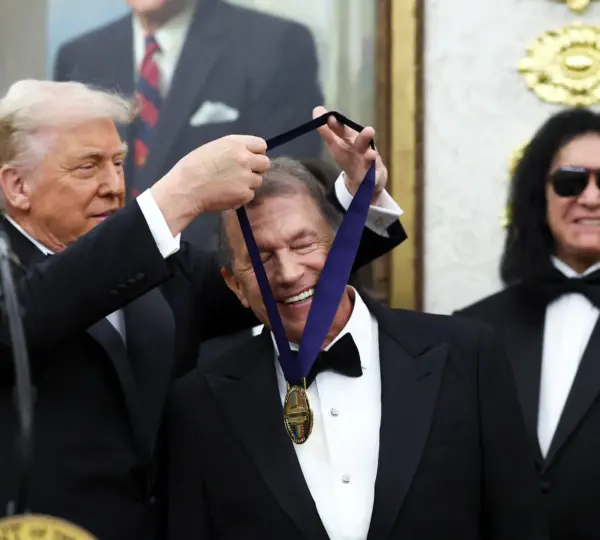
He neither commented on political dynamics nor reacted visibly to the heightened circumstances of the evening. In that, he remained consistent with a career built on approachability, professionalism, and musical sincerity.
In the annals of televised cultural ceremonies, sometimes the smallest details endure because they reflect something more universal — a pause, a shape, a shared glance that asks nothing of an audience except to observe.
At the 2025 Kennedy Center Honors, the shared seat between George Strait and Donald Trump offered such a moment: a brief image of coexistence that invited attention without demanding interpretation.
In doing so, it captured something rare in public life — the possibility that culture and politics can inhabit the same space, and that sometimes, merely bearing witness to art and history is more significant than any deliberate statement ever could.