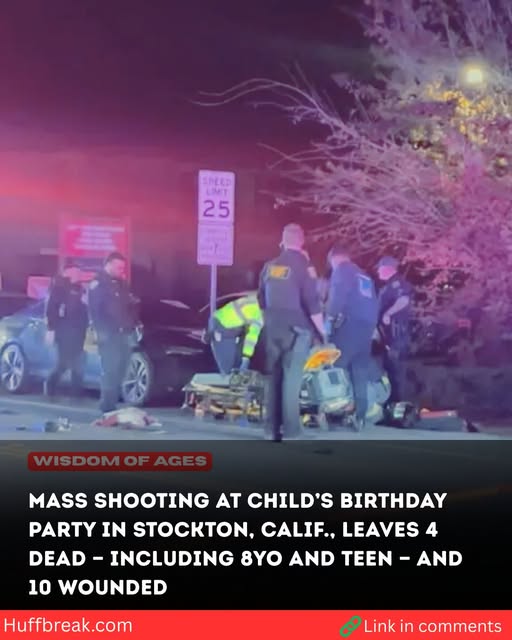
What was meant to be a joyful gathering in Stockton, California — a child’s birthday celebration filled with laughter, bright decorations, and families reconnecting — quickly shifted into one of the city’s most heartbreaking incidents in recent memory. The event, held at a local party venue known as Monkey Space, was supposed to bring parents, children, and neighbors together for a carefree evening. Instead, a burst of gunfire shattered what should have been an ordinary milestone for a young child, leaving the community grieving, fearful, and searching for answers.
According to early reports, the shooting began shortly before 6 p.m., catching attendees off guard during what should have been the most lighthearted moment of the weekend. Families had gathered around tables decorated with balloons and cake trays, while children ran through the indoor play area, a place typically known for laughter and safety. But in a matter of seconds, everything changed.
By the time the gunfire ended, four individuals — ages 8, 14, 22, and 30 — had tragically lost their lives, and ten more people were wounded, several of them minors. The incident immediately prompted a massive law enforcement response, with emergency vehicles crowding the parking lot, helicopters circling overhead, and officers working to secure the area.
Though investigators believe the attack was targeted, officials emphasized that the presence of families, children, and innocent attendees magnified the devastation. With the suspect still at large in the hours following the tragedy, local leaders urged community members to speak up and come forward with any information that could help identify those responsible.
The incident has once again placed Stockton under a painful spotlight. A city that has long grappled with high rates of violence, economic strain, and uneven access to community resources finds itself confronting a tragedy that has pushed residents to their emotional limits. The birthday party shooting has become not just another crime scene but a moment that demands reflection, change, and conversations about how to protect the city’s youth and rebuild trust in its institutions.
This long-form article examines the tragedy from multiple angles, offering a deeper look at the timeline, the community’s response, the ongoing investigation, the broader social context of violence in Stockton, and what residents, leaders, and policy experts believe must come next.
A Celebration Turned Nightmare: What Happened Inside Monkey Space
Monkey Space is a well-known children’s party venue in Stockton — a bright, colorful indoor space designed to give families a safe and lively environment for birthdays and weekend celebrations. On the evening of the incident, the venue was fully booked. Guests were chatting, children were playing tag between the bouncing structures, and parents were taking photos as the birthday child prepared to blow out candles.Just before 6 p.m., multiple attendees reported hearing what sounded like loud pops. At first, many thought it was balloons bursting or part of a party game. But when guests saw people rushing toward the exits and children diving behind tables, it became clear that something far more serious was happening.
Witnesses later described the scene as “chaotic,” “surreal,” and “terrifying.” Parents shielded their children, many dropping to the floor or pressing themselves against walls and furniture. Some ran toward offices and supply rooms to take shelter, while others raced toward the exits unsure of the safest direction to go.
When the gunfire stopped, the aftermath revealed the devastating truth — several individuals, including children, had been struck. Within minutes, police cars, ambulances, and fire trucks flooded the parking lot. The swift arrival of first responders prevented further loss of life, but the tragedy had already left an irreversible mark on the community.
A City Already on Edge
Stockton is no stranger to difficult headlines. For decades, the city has grappled with high rates of violent crime, economic disparities, and pressure on public services. Many residents feel caught between wanting to make their city safer and struggling with the everyday realities of life in a place that has often struggled to contain violence.
For a community accustomed to navigating safety concerns, the fact that this incident occurred at a child’s birthday party — arguably one of the most innocent and cherished family traditions — struck an especially painful nerve.
Events like this shift the public conversation from abstract crime statistics to something deeply personal. As one local parent put it:
“You expect to feel safe at a birthday party. You expect your kids to feel safe. When something like this happens in a place designed for children, it feels like nothing is off-limits anymore.”
This tragedy unfolded not in the early morning hours, not in an isolated alley, and not as part of a late-night conflict — but at a family event in broad daylight. That stark contrast between setting and violence has amplified the sense of urgency for community members and leaders to address the root causes of such incidents.
The Age Range of Victims: A Snapshot of Multigenerational Loss
The ages of the victims — 8, 14, 22, and 30 — highlight a disturbing trend seen in many U.S. communities: violence impacts people of all ages, often pulling young people into circumstances that should have never touched them.
- The 8-year-old victim — a child likely still in elementary school — represented the innocence stolen from the community.
- The 14-year-old may have been celebrating with relatives or classmates, navigating adolescence but still young enough to be excited by birthday games and cake.
- The 22- and 30-year-old victims were likely friends or family members attending to support the celebration.
The tragedy did not target any one age group — it affected the entire community spectrum. That fact alone has deepened the grief felt across Stockton.
What Investigators Know So Far
Though early information has been limited, law enforcement officials have emphasized several key points:
1. The Shooting Appears Targeted
Police believe the attack may not have been random. This suggests the perpetrator(s) had a specific objective, though why they chose to carry out violence in a public space filled with children remains unclear.
2. Shots Came From Multiple Directions
Witness accounts suggest gunfire may have originated from more than one location. This raises questions about the planning, number of individuals involved, and the attacker(s)’ movements in the minutes leading up to the incident.3. A Search for the Suspect Is Still Ongoing
At the time of the initial report, the suspect had not yet been apprehended. This uncertainty has left residents anxious, hoping for answers and justice.
4. Authorities Are Requesting Community Assistance
Officials have urged witnesses and residents to share any videos, photos, or firsthand accounts that might aid the investigation. Even small details could prove crucial.
Local Leaders Speak Out: A Plea for Unity and Cooperation
Stockton’s officials — many of whom have personal or professional experience with the trauma of losing loved ones to violence — addressed the public with a mixture of sadness and determination. Their messages focused on two central ideas:
- Stockton residents should not become numb to violence.
- Community support is essential to prevent future tragedies.
One council member shared:
“Our city is strong, but our strength cannot become an excuse to accept tragedy as normal. This should never happen — not here, not anywhere, and certainly not at an event meant to honor a child.”
Another official emphasized the importance of community cooperation in solving the case:
“Someone knows something. We need people to step up. We need to protect our children and our future.”
These statements underscore the shared responsibility residents feel toward rebuilding trust, healing from trauma, and supporting solutions that address both immediate safety concerns and long-term structural issues.
Understanding the Larger Picture: Violence and Its Roots in Stockton
To understand why incidents like these continue to occur, even in settings meant for celebration, it’s essential to consider the deeper issues that Stockton — like many American cities — has been facing.
1. Economic Strain
Stockton has experienced cycles of economic instability, including a municipal bankruptcy in 2012. Many families still face:
- income inequality
- limited access to stable employment
- rising housing costs
- financial stress that affects community dynamics
Such conditions often contribute to environments where violence becomes more common.2. Limited Youth Opportunities
Young people in Stockton have access to programs and community centers, but resources often fall short of the need. When opportunities are limited, cycles of violence can take hold more easily.
3. Interpersonal Conflicts Escalating Into Violence
Some violent incidents arise from interpersonal disputes that escalate due to lack of conflict resolution resources, mentorship programs, or community mediation services.
4. Access to Weapons
Like many cities, Stockton struggles with illegal firearm circulation, which increases the likelihood that conflicts turn deadly.
5. Structural Inequalities
Generational poverty, housing instability, and uneven access to mental-health resources all contribute to circumstances in which violence becomes more prevalent.
The birthday party shooting cannot be viewed in isolation. It represents a symptom of deeper community challenges that require coordinated, thoughtful, and sustained solutions.
A City in Mourning: How Residents Are Responding
In the hours following the incident, community members gathered outside the venue, many holding candles or placing flowers near the entrance. Some prayed quietly, while others hugged, cried, or simply stood silently in solidarity.
Parents who attended the party described the trauma of trying to protect their children or finding them amid the chaos. Even those who were not physically injured expressed feelings of shock, guilt, fear, and profound sadness.
Local counselors have emphasized the importance of providing immediate mental-health support for:
- children who witnessed the event
- parents and caregivers traumatized by the experience
- venue employees
- first responders
- extended family members
- the community at large
Addressing emotional wounds early helps prevent long-term psychological harm.
How Communities Heal After Violence
Research suggests that communities recover from traumatic events through several key approaches:
1. Public Acknowledgment
Openly addressing what happened validates the pain felt and sets the stage for healing.
2. Accessible Counseling Services
Free or low-cost trauma-informed counseling can make a significant difference for children and adults.
3. Community Forums
Town halls, support circles, and moderated discussions provide safe spaces for sharing experiences and rebuilding trust.
4. Support for Affected Families
Fundraisers, meal deliveries, and resource drives help families navigate unexpected loss.
5. Policy and Prevention Initiatives
Meaningful change often requires structural reforms, such as safety programs, youth initiatives, and community investment.
Stockton leaders have already begun coordinating these responses, recognizing that healing is not a short-term process but a long-term commitment.
The Role of Community Partnerships
Addressing the root causes of violence involves collaboration among:
- schools
- nonprofit organizations
- faith communities
- mental-health professionals
- local government
- law enforcement
- youth programs
- neighborhood associations
For example, mentorship programs can provide guidance for young people navigating difficult environments. Community centers can host safe after-school activities. Local businesses can contribute to neighborhood revitalization projects. Mental-health professionals can offer ongoing support services.
What Experts Say Must Come Next
Policy analysts and violence-prevention experts emphasize several key strategies:
1. Expanded Youth Resources
Providing structured programs, safe spaces, and mentorship can significantly reduce the risk of violence.
2. Strengthened Community Trust
Open communication between law enforcement and residents encourages cooperation essential for solving crimes and preventing future incidents.
3. Investment in Mental-Health Services
Trauma has long-lasting effects; mental-health support is essential for both healing and prevention.
4. Data-Informed Public Safety Strategies
Cities that use real-time data often prevent violence before it occurs through targeted interventions.
5. Long-Term Economic Investment
Stable employment and community development reduce the circumstances that allow violence to flourish.
A City Determined to Rebuild
While Stockton faces immense challenges, the community’s resilience remains strong. Residents are committed to honoring the victims, supporting grieving families, and working together to create a safer environment for children.
Tragedies like this are not just moments of loss — they are turning points that push communities, leaders, and families to re-examine priorities and pursue meaningful change.
The birthday party shooting has left Stockton heartbroken, but it has also reignited conversations about:
- protecting youth
- strengthening neighborhoods
- increasing access to support services
- preventing future incidents
- promoting healing and unity
In times of grief, communities often discover strength they didn’t know they had. Stockton, once again confronted with a difficult moment, is choosing to stand together, support one another, and look forward to a future where celebrations can remain joyful — and safe — for every child.